
View the Eclipse With Only Shade 14 Solar Eclipse Glasses
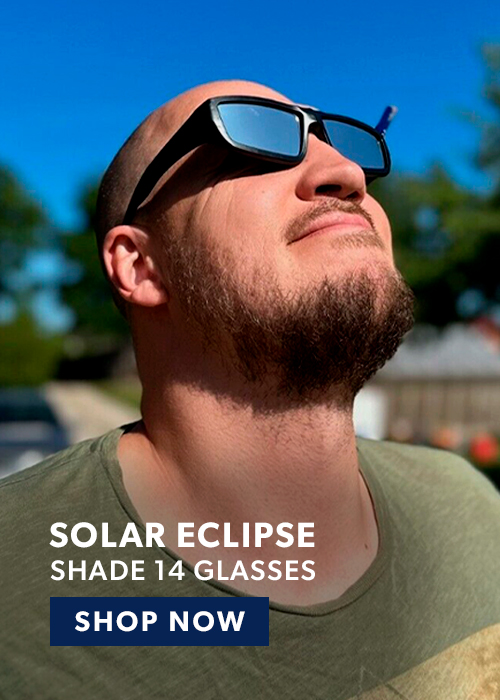


Shade 14 glasses are the safest way to view a solar eclipse. Protect your eyesight during this spectacular event by using these specially designed glasses.
Shade 14 glasses provide the highest level of protection for viewing solar eclipses. They are designed to block harmful ultraviolet (UV) rays and intense visible light, ensuring your eyes are safe from potential damage. These glasses are essential because direct exposure to the Sun’s light, even during an eclipse, can cause serious eye injuries.
Looking directly at the Sun can lead to permanent eye damage. The Sun’s intense light, including its ultraviolet and visible radiation, can burn your retinas and cause vision problems. This is true even when the Sun is partially obscured by the Moon.
Sunglasses, cameras, binoculars, and telescopes are not safe for viewing solar eclipses. They do not provide the necessary protection against the Sun’s harmful rays. Only certified solar eclipse glasses, like Shade 14, offer the level of safety required to protect your eyes during the eclipse.
Don’t wait until the last minute to buy eclipse glasses. Ensure you purchase from a reputable manufacturer known for producing high-quality protective eyewear. Avoid unproven glasses from unknown sources to protect your vision during this extraordinary event.
For questions about Shade 14 solar eclipse glasses or to get more information, contact us today.
Welding without proper protection poses many dangers to your eyes. That’s why welders need to always wear safety glasses or goggles or a safety hood that guards their vision. Many wear glasses underneath their hoods. In the history of welding safety lenses, one brand name has become legendary in the profession: American Optics Safety Weld Cool filter plate, usually called “Cool Blue.” Although AO discontinued the product in 1990, welders still talk about how great they are at protecting eyesight and removing the yellow flare of the contact arc. That allows welders to clearly see what they are doing. Welders still prize those glasses so much they go for $4-500 a pair on eBay when you can find a listing for them. Working welders treasure their Cool Blues and hang on to them.
Why did American Optics stop manufacturing them? That’s not known in detail. According to an email from the Product Line Director, they had a problem in the manufacturing of the blue base glass, a specialized form of cobalt glass. Evidently, they decided reformulating the base glass would be so expensive they could not continue to make a profit. At that time, many welders were switching from passive filter lenses to auto-darkening lenses. If Cool Blues became too expensive, AO feared, more welders would switch to those types of lenses. These days, auto-darkening lenses do not darken quickly enough to prevent eye problems. It takes only a bit of radiation to flash through the lens of your eye in a millisecond to burn a permanent hole in your retina. Therefore, workers’ compensation doesn’t want to pay for claims made by workers who used them. Therefore, many shops do not allow these types of glasses.
Failure to use proper goggles or a face mask exposes your eyes to excess radiation that causes “arc eye,” “flash burn,” or photokeratitis. That’s severe inflammation, like a sunburn, of your cornea and your eye’s conjunctiva. It also puts you at a higher risk of developing cataracts. Eye problems cause one-quarter of all welding injuries. All eye protection should comply with ANSI Z87.1.
Phillips Safety intends to replace your regular welding lens with their AlloWeld lenses. Phillips designed them to outperform the AO Cool Blue glasses by eliminating the yellow to near-orange shades of the spectrum so the flame and flare of the arc do not block your vision. They make the lenses from German glass that’s high in quality and free of distortion.
Glass lenses are far superior to plastic or polycarbonate because everything you see through them is clearer. Phillips starts with standard green welding glass that protects your eyes from both IR and UV and creates a composite that eliminates the yellow to near-orange light of the arc. It also enhances contrast to improve your vision quality. The rare earth elements in the glass increase color contrast, making it easier to determine the material’s temperature and puddling. They meet ANSI standards for welding lenses. They are highly durable and scratch-resistant.
They’re made to braze and weld aluminum, cast iron, and stainless steel, so they’re great for welding and brazing work on Aircraft, Automobiles, Boats, Racecars, Refrigeration units, and Radiators. The lenses come in dark emerald-green shades, 4,5,6, 8, 9, 10, 11, 12, 13, and 14. They also come with a gold coating. The gold coating reflects 90% of radiant heat. This keeps your eyes cooler and less tired during long welding sessions. Plus, the AlloWeld lenses come in two sizes: Small 2 X 4.25 and Large 4.5 X 5.25.
The AlloWeld outdoes the old Cool Blue glasses by completely eliminating the yellow-orange flare of the arc. With AlloWeld, you see the weld puddle as it forms. You see the arc wearing down the electrode. You see your work as you perform it. They’re completely safe because they block 100% of both the infrared and ultraviolet radiation given off during the welding process. This protects your eyesight from the long-term effects of exposure to IR and UV light.

Another Phillips product to protect the eyesight of welders is the Super Magenta Drop-In Lenses. They are drop-ins, so you must use them with your standard welding shade. They make the lenses of advanced acrylic, also eliminating the yellow to the near-orange flare of the arc. And they enhance the other colors. Users report excellent color separation, clarity, and overall viewing quality.

Optically, they are as good as glass lenses. Standard green welding shades reduce visible light, but the welding arc remains extremely bright, painful, and potentially eye-damaging. The bright flame interferes with your view of your work, reducing your quality. By eliminating the yellow and orange shade of the spectrum, Super Magenta gets rid of the visual flair and enhances your view of the task at hand. The Super Magenta adds about 1/2 to the shade of your normal welding lenses.
Phillips Safety’s Super Magenta Drop-In Lenses come in three sizes: Small Rectangle 2 x 4.25, Large Rectangle 4.5 X 5.25, and Circular 50 mm in diameter. Protect them from spatter because it can pit the acrylic. For the same reason, keep them in the packing envelope or otherwise protected when not in use. You can also use them in the cheater holder of an auto-darkening hood.
Attention! Never use Super Magenta drop-ins as standalone lenses while welding. You still need standard shades to protect your eyes from IR radiation. Using only Super Magenta lenses will damage your eyes. They block ultraviolet but not infrared.
In conclusion, welding without proper eye protection poses significant risks, including severe conditions like “arc eye” and increased chances of cataracts. Historically, the American Optics Safety Weld Cool Blue filter plates were highly valued for their exceptional protection and clarity, although they are no longer in production. Modern alternatives, such as Phillips Safety’s AlloWeld lenses and Super Magenta Drop-In Lenses, have advanced the technology further. AlloWeld lenses offer superior performance by eliminating yellow to orange flares and providing high clarity through high-quality German glass, making them ideal for various welding tasks. Meanwhile, Super Magenta Drop-In Lenses enhance color separation and clarity when used with standard welding shades, further improving safety and precision in welding work.
By investing in high-quality lenses like AlloWeld and using supplementary lenses such as Super Magenta, welders can protect their vision effectively, maintain high productivity, and uphold safety standards in their work environments. At Phillips Safety Products, we carry a full line of AlloWeld and Super Magenta welding safety glasses and supplies. Contact us today.
When it comes to welding, protecting your eyes is paramount. That’s why choosing the right welding lens is crucial for safety. Welding equipment like goggles, helmets, and masks all rely on quality glass safety lenses to shield your eyes and face from potential harm. But not all lenses are created equal. Some provide only basic protection from sparks and debris, leaving your eyes vulnerable to harmful infrared (IR) and ultraviolet (UV) rays. Understanding the differences between lens options is key to ensuring your safety on the job.
At Phillips Safety Products, Inc., we’re dedicated to offering a diverse array of high-quality welding lenses, each renowned for its exceptional quality and strict adherence to industry safety standards. Our lenses boast a range of features that set them apart: available in standard sizes and shades, with customizable options upon request; they provide added safety by offering protection from sodium flare; meticulously crafted from premium German glass, ensuring distortion-free, striation-free, and bubble-free performance; and our extensive welding product line includes eyewear, sheets, and lenses tailored to a wide range of welding applications.
Now, let’s dive into a comparative analysis of our top-tier welding lens options: green lenses and gold-coated lenses. These lenses are specifically designed to cater to the diverse needs of welders, offering distinct advantages and features. By examining their unique qualities and benefits, we aim to provide you with the insights necessary to make an informed decision regarding your eye protection requirements.
Our green welding lenses, manufactured by Schott Glass in Germany, offer comprehensive protection from all three types of welding radiation. These lenses boast exceptional optical clarity and visual acuity, with a grey-green tint that reduces eye fatigue by dimming bright flares and minimizing scattered light. Photometrically tested to meet optical class 1 standards, these lenses are a top choice for eye protection.
Key Features:
Our gold-coated welding lenses provide all the benefits of green lenses, with the added advantage of extra protection from infrared radiation. Featuring a gold mirror coating on the standard green lens, these lenses reflect 90% of infrared radiation, reducing heat exposure to the eyes. The reflective surface also helps minimize eye strain, making them ideal for prolonged welding sessions.
Key Features:
We take pride in our collaboration with Schott Glass to provide outstanding eye protection solutions. Our extensive range of lenses offers unparalleled defense against welding radiation hazards, guaranteeing your safety during work. Whether you require eyewear, sheeting, or lenses, we offer a comprehensive selection to meet your needs. Explore our full collection of welding safety products on our website or reach out to us directly for more information or to request personalized solutions. Your safety remains our utmost priority.
If you work around lasers, you know just how imperative eye safety can be. Laser safety glasses are made for workers in many fields, including medical, military, and industrial laser applications. The beauty of laser safety glasses is that they are all designed to serve the same crucial function: protecting your eyes from damage caused by high-powered laser light. Of course, there are lots of laser safety products available, and selecting the correct pair for your laser is essential. Many considerations will affect which safety glasses you choose, so read on for more information.
The technology of lasers is constantly in flux, changing and advancing as research leads to new improvements. So, the first step in selecting a pair of safety glasses is to ensure you are comparing glasses that are updated and meet the highest possible standards. Luckily, Phillips Safety Products, Inc. utilizes the newest laser research and works with leading testing labs worldwide so that their eyewear always meets the ANSI Z136 standards for laser eye protection. That said, here’s a step-by-step guide detailing how to select the laser safety glasses that best suit your needs.
First and foremost, you will need to know as much about your laser’s operating system as possible. Before you purchase a pair of laser safety glasses, you must clearly understand the needs your laser dictates. Collect information about your laser’s specifications, focusing on the operating wavelength, power output, beam diameter, delivery system, and the industry you work in. The output and power are typically listed directly on the laser; most other information can be found in the operator’s manual. This data will help determine which laser glasses will block the appropriate wavelength range at the correct optical density (OD). If you cannot determine the operating parameters of your laser, consult with a Certified Laser Safety Officer (CLSO). If you do not have a CLSO on staff, please get in touch with Phillips Safety Products, Inc. for a free consultation and OD calculation.
The operating parameters of your laser will determine what wavelengths you’ll want to absorb or block and at what OD. Wavelength refers to the “spatial period” of a wave of light. The waves are measured from crest to crest or valley to valley and placed on an electromagnetic spectrum (known as the light spectrum) from shortest to longest. Certain waves are not part of the visible spectrum, and, in the case of lasers, these ultraviolet waves can be of great danger to our eyes. Thus, determining the wavelength output of your laser will determine what wavelengths you need to block. Optical density is more complex, but it is essentially a ratio that measures the absorbance of particular wavelengths. OD is essential because it will determine how effectively your safety glasses absorb the wavelengths from which you need protection. Once you understand your wavelength and OD needs, the next step is to consider your filter options.


Phillips Safety Products, Inc. has various filter lenses to meet every laser eyewear requirement. Lenses are either polycarbonate or glass and can be selected by wavelength (measured in nanometers) and OD level. All filters offer excellent visible light transmission, providing the best visual acuity possible. The polycarbonate lenses are more affordable than the glass, lightweight, and impact-resistant. These filters offer a variety of wavelength absorption. They are typically used for low- to mid-power density laser applications. Glass lenses are necessary for certain power levels and wavelengths, offering a degree of protection that polycarbonate cannot. These filters have a higher visible light transmission rate and can achieve higher OD levels with increased thickness.
Should you need an even more specialized pair of glasses, many standard pairs can also be fitted with prescription lenses. Though this is one of the last steps in the ordering process, if this is an essential factor, ensure you are searching for glasses marked “RX-Able.” Adding your prescription to your safety glasses is a fantastic advantage. You can see correctly, and your safety glasses can be properly situated on your face, unimpeded by a second pair of spectacles beneath.
Typically, your frame options are limited to what lens you have chosen, but there are plenty of options. As we said, style is hardly considered where laser safety glasses are concerned, but we have many designs. These designs vary in flexibility, adjustability, and how much of the outer eye area is covered. Please get in touch with us if you have any questions about laser eyewear or need help choosing your perfect par. We are happy to help and can’t wait to meet all your safety needs.
Hydroponic indoor gardening is a growing trend in private homes and in the farming industry. The amazing technology of high-powered grow lights is quickly changing how grower’s manage and maintain their crops, allowing for greater yields despite limited terrain. However, the obvious advantages that this system provides are not without a few drawbacks that ought to be addressed. Namely, the fact that high-intensity grow lights emit radiation that is harmful to the human eye. Aside from damage to the farmers, damage to crops is also a possibility since harsh grow lights impair a grower’s observation of their plants, rendering farming techniques useless.
In order to counteract both these problematic setbacks Phillips Safety Products, Inc. has developed an all-in-one solution in the form of grow light safety glasses. Our Hydrospecs Growers line of glasses is an optimally designed feat of science that protects the eyes and gives you the ability to see every little detail that glaring lights may have hidden from you before. Let us help you filter out excess light and offer you protection for lasting eye health and a great gardening experience.
Today, we’ll be focusing specifically on our line of glasses that protect against high-pressure sodium (HPS) lights. Below you’ll find a breakdown of the most frequently asked questions regarding HPS grow light safety glasses and what they can do for you.
Simply put: Hydrospecs Growers safety glasses utilize specialty lenses to filter out unwanted light. Because indoor gardening requires a light source that is of a much higher intensity than natural light the viewing of minute details is quite impossible. It also means that you – and your eyes – are exposed to higher rates of UVA, UVB, and UVC radiation. In answer to this, our glasses are specifically tailored to match the frequencies of different hydroponic light sources (like HPS) and their characteristics. The lenses are designed to absorb or reflect these wavelengths, providing you with protection as well as perfect vision.
High-Pressure Sodium is one of the most commonly used lighting systems in hydroponic lighting technology. HPS has excellent spectral distribution and produces high levels of the yellow and red end of the color spectrum. Like other hydroponic gardening lights HPS is very strong and capable of producing high quantity as well as high-quality crops. The characteristics of this lighting are particularly favored for growing fruits and flowers.

Simply put: Hydrospecs Growers safety glasses utilize specialty lenses to filter out unwanted light. Because indoor gardening requires a light source that is of a much higher intensity than natural light the viewing of minute details is quite impossible. It also means that you – and your eyes – are exposed to higher rates of UVA, UVB, and UVC radiation. In answer to this, our glasses are specifically tailored to match the frequencies of different hydroponic light sources (like HPS) and their characteristics. The lenses are designed to absorb or reflect these wavelengths, providing you with protection as well as perfect vision.
High-Pressure Sodium is one of the most commonly used lighting systems in hydroponic lighting technology. HPS has excellent spectral distribution and produces high levels of the yellow and red end of the color spectrum. Like other hydroponic gardening lights HPS is very strong and capable of producing high quantity as well as high-quality crops. The characteristics of this lighting are particularly favored for growing fruits and flowers.

Just as the sun emits radiation so too do high-intensity grow lights. HPS emits UVA, UVB, and UVC at rates that can be harmful without proper protection. UVC rays are particularly dangerous because the ozone layer naturally filters them out and we are rarely exposed to them. Because UVC rays are almost alien to us, specialty glasses are an absolute necessity. You see, typical sunglasses are not engineered to filter out UVC rays so they are quite useless for protection during indoor gardening activities.
UVC rays are an ultraviolet ray which can cause serious damage to the human eye. Though it is excellent for plants it can create discomforts such as headaches and eye fatigue in farmers. Prolonged exposure can result in even worse diagnoses. Permanent damage such as impaired color perception, cataracts, and loss of vision can all result from exposure to the UVC radiation emitted from HPS lighting systems. These are very real and serious risks that you face while performing hydroponic indoor gardening without proper protection.
In conclusion, hydroponic indoor gardening offers remarkable benefits, especially with the advancement of high-powered grow lights that boost crop yields significantly. However, these advantages come with the critical challenge of protecting growers from harmful radiation emitted by high-intensity lights, particularly High-Pressure Sodium (HPS) systems. Phillips Safety addresses this issue with our Hydrospecs Growers line of safety glasses, specifically designed to shield the eyes from dangerous UVA, UVB, and UVC rays. By incorporating these specialized glasses into your gardening routine, you can enjoy both enhanced visibility and lasting eye health, ensuring a safer and more effective hydroponic gardening experience.
For hundreds of years, bifocal lenses have provided wearers the ability to see up close and far away without changing their eyeglasses. Mostly, this is helpful for reading on the go without having to switch to a pair of reading glasses. This is especially true in dangerous work environments where workers have their hands busy with their work duties, which is why bifocal safety glasses were created. In an effort to help buyers understand their options, let’s examine 5 things to consider when choosing bifocal safety glasses: strength of bifocals, style and material of frame, type and color of lenses, extra capabilities, and affordability and place of purchase.
The first factor to consider when choosing bifocal safety glasses is understanding what strength of magnification is needed. The units of correctional strength are measured in what’s called Diopters, which range in increments of 0.25 typically, for instance: +1.0, +1.5, +3.0. Generally, +3.0 is the strongest Diopter unit wearers will need.
To find out exactly what strength of bifocals is needed, tests are available online or a person could try some different strengths out at a local department or eyeglasses store. A prescription isn’t needed to buy bifocal lenses, so reading glasses can be found over the counter at most department stores and pharmacies.
This factor is important to consider carefully because it has a lot to do with the overall functionality of the bifocal safety glasses. Inherently, safety glasses are designed to fully cover the eyes, providing varying levels of protection from projectiles and particulates within a working environment. Buyers need to choose the safety glasses that will fit the work environment they’ll be used in, which has a lot to do with the style and materials of the frames.
The selection for bifocal safety glasses has expanded over the years, yet, generally, there are two different types: full framed and semi-rimless frames. The frames are either made from plastic or nylon materials, and are designed to be impact resistant, durable, and lightweight. Depending on the level of protection needed, the frames can be thicker; generally, they have wrap-around arms with a breathable nose bridge and soft rubber tips on the arm end – keeping them snugly and comfortably fit on the wearer’s head.
Frames are designed to fit universally and be used by either sex, yet more expensive safety glasses provide more flexibility, comfort, and protection. Choosing the style and material of the frame is partially a subjective choice for aesthetics; frames come in many different colors and styles. Also, buyers should ascertain what safety rating the bifocal safety glasses have, such as if they’re ANSI-approved and/or OSHA complaint.


Choosing the lens type and color is an important factor to consider, as the lenses provide the most functionality and protection with bifocal safety glasses. Already, the bifocal lenses are helpful for workers with correctional needs for reading or seeing up close objects better, but lenses also can be used as sunglasses and for varying levels of protection.
The most robust lenses are ballistics-rated, impact-resistant, polycarbonate lenses. These provide the most protection for wearers, but also provide multi-functionality by turning clear indoors and gray outdoors in the direct sun. These lenses provide 100% UVA/UVB protection in the direct sunlight, then turn clear when indoors, making them extremely convenient for certain work environments. Keep in mind, these lenses turn gray when in direct sunlight, which means when they’re used in vehicles they won’t work the same, because most windshields are coated to block UV rays.
For buyers who need light-duty bifocal safety glasses, semi-rimless, non-polycarbonate lenses are available for much less. Make sure these are still ANSI-approved, to be sure they’ll provide durable protection for lighter uses – for a fraction of the price. To find out exactly what strength of bifocals is needed, tests are available online or a person could try some different strengths out at a local department or eyeglasses store. A prescription isn’t needed to buy bifocal lenses, so reading glasses can be found over the counter at most department stores and pharmacies.
Another factor to consider is: what extra capabilities does the bifocal safety glasses have? For instance, are they thick enough to attach small lights to the sides, can the arms easily be attached to a retainer, or can the parts be removed and replaced? For most uses, standard, full rimmed, thick plastic or nylon frames with polycarbonate lenses will work fine, yet some work environments may require special capabilities – like built-in small flashlights on the sides or double bifocal lenses (top and bottom).
Choosing the lens type and color is an important factor to consider, as the lenses provide the most functionality and protection with bifocal safety glasses. Already, the bifocal lenses are helpful for workers with correctional needs for reading or seeing up close objects better, but lenses also can be used as sunglasses and for varying levels of protection.
The most robust lenses are ballistics-rated, impact-resistant, polycarbonate lenses. These provide the most protection for wearers, but also provide multi-functionality by turning clear indoors and gray outdoors in the direct sun. These lenses provide 100% UVA/UVB protection in the direct sunlight, then turn clear when indoors, making them extremely convenient for certain work environments. Keep in mind, these lenses turn gray when in direct sunlight, which means when they’re used in vehicles they won’t work the same, because most windshields are coated to block UV rays.
For buyers who need light-duty bifocal safety glasses, semi-rimless, non-polycarbonate lenses are available for much less. Make sure these are still ANSI-approved, to be sure they’ll provide durable protection for lighter uses – for a fraction of the price. To find out exactly what strength of bifocals is needed, tests are available online or a person could try some different strengths out at a local department or eyeglasses store. A prescription isn’t needed to buy bifocal lenses, so reading glasses can be found over the counter at most department stores and pharmacies.
Another factor to consider is: what extra capabilities does the bifocal safety glasses have? For instance, are they thick enough to attach small lights to the sides, can the arms easily be attached to a retainer, or can the parts be removed and replaced? For most uses, standard, full rimmed, thick plastic or nylon frames with polycarbonate lenses will work fine, yet some work environments may require special capabilities – like built-in small flashlights on the sides or double bifocal lenses (top and bottom).
The last factor to consider is, of course, the price tag and place of purchase, which often work together. Buyers want to avoid cheap products, yet still, get a good deal for a quality product. Buying bifocal safety glasses manufacturer-direct online from Phillips Safety, for instance, gives buyers wholesale prices at a discount for quality products. Buyers should ascertain whether the place of purchase has discounted bulk rates, free shipping, good selection, fair return policy, and quality products. They should also consider the experience, expertise, customer service, shipping and handling policies, and reputation of the company, in order to validate the quality of their products and ensure a good buying experience.
Many work environments require safety glasses, and bifocal safety glasses make it safer and more convenient for workers to see clearly from far away and up close without switching glasses. Bifocal safety glasses are a major improvement in workplace safety, especially with polycarbonate lenses, which Photochromic from indoors to outdoors – making them even more convenient and safe. Comfort, durability, expanded capabilities, and added protection have also improved over the years.
These 5 factors to consider should help buyers choose the right bifocal safety glasses for the specific uses they need. Subjective tastes, bulk or individual ordering, and specific work environments will also factor into the overall decision buyers make. For 75 years, Phillips Safety has been manufacturing optical lenses for safety glasses for all applications, including military and industrial, and has the experience, expertise, and quality products that buyers can count on. Please contact us to learn more about our bifocal safety glasses.
Laser safety glasses have become increasingly important in several industries, but lately, their importance and necessity aboard military and civilian aircraft pilots are receiving much attention. In 2014, the Federal Aviation Administration (FAA) claimed that laser strikes on aircraft occurred an average of eleven times daily. This number has increased dramatically in the last two years.
Laser strikes on aircraft have been on an alarming upward trend, with over 7,000 strikes reported in 2015 alone. 2023’s data has not yet been released, but the FAA expects these numbers to continue growing even though it is now a federal crime to point lasers at aircraft. Pointing lasers at aircraft can be punishable by 20 years in prison and a $250,000 fine. However, there is rampant ignorance regarding the dangers of pointing lasers at planes and helicopters, and it can be challenging to track down offenders. This growing problem cannot be taken lightly, as pilots – commercial, military, and civilian alike – are in danger of being distracted and temporarily blinded by high-powered, long-range lasers. Though the risks are most acute during take-off and landing, laser sightings have been reported at over 10,000 feet.
With the ever-growing threat of laser interference, it is time for pilots to protect themselves and utilize laser defense technology. Laser Strike Eyewear by Phillips Safety Products, Inc. has been designed and manufactured to block and reduce laser beam wavelengths. Though this eyewear was initially developed for the US military, it is now available for civilian pilots, offering protection and visual clarity for safety on the job.
Phillips Safety Laser Strike Eyewear employs a functional design that can be worn over prescription glasses, under headsets, and helmets. Laser Strike Eyewear is guaranteed lightweight and durable, with a reliable one-year warranty against manufacturer defects. Many frame options are available for style preference, but the technology is in the specially developed polycarbonate lenses that absorb dangerous laser light.
The unique absorption of the wavelength of light in Laser Strike Eyewear offers complete protection from all three laser color spectrums. The spectrums of laser color are determined by wavelength, so the lenses are designed to filter and block specific wavelengths without distorting or obstructing your eyesight or your ability to see and work with essential instrumentation.
Our lenses are designed for maximum visibility and protection. The competitor lenses are admittedly darker than ours and may make it more challenging to see. The most difficult process of making the best laser lenses is to block just the laser wavelength to protect your eyes but not too much of the visible light spectrum so that the lenses become too dark to fly the plane. The lens shading level is based on which lens you choose.
We manufacture three Laser Strike lens options:
Offering protection from and reduction of green laser beams.
Offers protection from, and reduction of, green and blue laser beams.
Offers protection from and reduction of green, blue, and red laser beams.
Each lens is designed to offer specific beam reduction, offering slightly different levels of visual light transmittance (VLT). VLT measures how much visible light goes through the lens in question. Our green beam reduction lenses offer the most visibility with a VLT of 46.9%. The darkest glasses – which protect against green, blue, and red – offer a VLT of 23.3%. These are significantly darker than the more basic lenses, but they do not impede vision.

Our lenses are thoroughly tested and held to the highest standards. We aim to provide a product that protects you from dangerous lasers and provides a comfortable experience. Laser Strike Eyewear is lightweight, strong, and available in many styles, from wraparound frames to heavy-duty goggles that easily fit over your regular prescription. Every frame, style, and lens has a product description that includes laser specifications, wavelength protection, VLT, and optical density. Phillips Safety Products, Inc. also has an excellent support staff ready to help you decide on the best product for your needs.
Laser protection is no inconsequential matter. As laser strikes on aircraft become common, it is essential to combat the possibilities of unseen and unpredictable danger. Many countries and airlines already utilize laser defense glasses as standard operating procedures. Even if you are not required to wear them, they are an excellent safety precaution for any pilot. The FAA and FBI are constantly in pursuit of people who recklessly endanger pilots by pointing lasers at planes. Still, unfortunately, with as many laser reports as there have been, it is difficult to make a significant dent in ending this problem.


The reality is that lasers have become increasingly cheap and easy to obtain, making it more difficult for these law enforcement agencies to stop laser negligence and irresponsible misuse. Laser defense eyewear provides protection, rendering laser strikes entirely harmless for pilots. Some countries have outlawed lasers, but this is not the case in most of the world, so it is essential to be proactive against a growing danger. Suppose you want to learn more about Laser Strike Eyewear or our laser safety products. In that case, don’t hesitate to contact us. Phillips Safety Products, Inc. has protected eyes for over 110 years and takes pride in our top-of-the-line technology.
We look forward to fulfilling all of your laser safety needs.