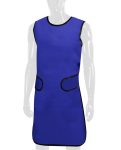
How to Choose a Lighter Radiation Apron Without Sacrificing Safety

Choice of Thinner (Lighter) Core

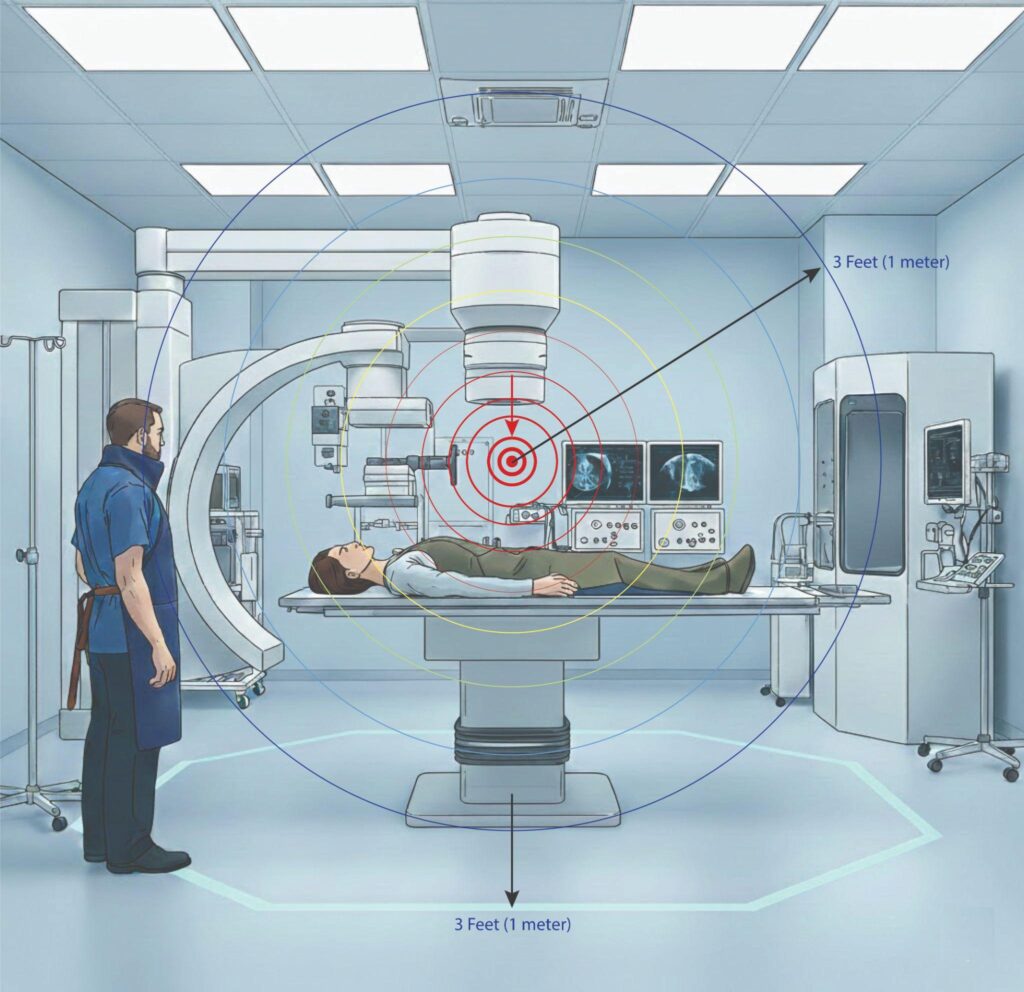
Choosing a core thickness less than 0.5 mm (such as 0.35 mm or 0.25 mm) is strictly predicated on maintaining a 1-meter (3-foot) distance threshold.

The Distance Advantage: A staff member wearing a 0.25 mm 1-Meter Apron receives approximately half the radiation dose (7.5 uSv) of a proximity worker wearing a 0.5 mm apron within .5 meter (14.0 uSv).

Choosing a lighter core while respecting the 1-meter threshold provides superior protection with a 50% reduction in garment weight.

The Proximity Zone
(< .5 Meters)

Within this table-side range, staff are exposed to high-intensity scatter. A 0.5 mm Pb core is the necessary standard for this proximity.

The Safety Zone
(≥ 1 Meter)

At this distance, the inverse square law reduces incident radiation intensity by approximately 90%. Only at this threshold does a lighter core become a viable, legally compliant option.
Quantifying the Attenuation (75-100 kVp)

The following data directly compares the transmitted dose for a proximity worker (at 0.5 meters) versus a distanced worker (at 1 meter). It demonstrates that distance trumps core thickness for overall dose reduction.

Core Thickness
Distance
Classification
Attenuation %
5-min Dose per Procedure
0.50 mm Pb
0.5 Meters
Proximity Apron
96.5% (.4 Primary)
14.0 uSv
0.35 mm Pb
1.0 Meter
1-Meter Apron
94.2% (.1 Primary)
5.8 uSv
0.25 mm Pb
1.0 Meter
1-Meter Apron
92.5% (.1 Primary)
7.5 uSv

CT Gantry Shadow Consideration

In CT environments, the gantry acts as a primary shield. For staff working within the Gantry Shadow at a 1-meter distance, 1-Meter Aprons (0.25 mm or 0.35 mm) are exceptionally effective as the shadow further reduces the energy and volume of scatter photons.

Legal Compliance and Safety Margin

The primary goal is remaining within the legal limit of 4166 uSv per month (0.416 rem).

High-Volume Scenario (24 Procedures per Day): Based on 480 procedures or 40 hours of beam time per month:

35 mm Core (at 1m)

Cumulative dose is 2800 uSv (0.28 rem), or 67% of the legal limit.

25 mm Core (at 1m)

Cumulative dose is 3600 uSv (0.36 rem), or 86% of the legal limit.

Even in high-volume environments, the 0.25 mm core keeps staff safely within legal exposure thresholds, provided the 1-meter distance is maintained.

Conclusion for the Buyer

If your clinical role allows you to maintain a 1-meter distance, a 0.25 mm or 0.35 mm core provides a safe, legally compliant experience that outperforms a standard 0.5 mm apron used at proximity. This “1-Meter Apron” classification enables an informed decision that balances maximum radiation protection with long-term orthopedic health.

If you still aren’t sure which lead aprons are right for you, it’s a good idea to give us a call at 1-866-575-1307 or talk to us through our chat or e-mail us at service@phillips-safety.com

Our experts will be able to tell you what you need for your application.

SHOP LEAD APRONS

Lead Acrylic vs. Leaded Glass Windows for Radiation Safety Barriers: Which is Better?

When it comes to choosing the best material for radiation safety barriers, particularly for windows, the decision often boils down to lead acrylic or leaded glass. Both materials are designed to shield against harmful radiation, but they have distinct differences in durability, weight, thickness, and lead equivalency. Understanding these differences can help you make an informed decision based on your specific needs.

Leaded glass has been the traditional choice for radiation safety barriers due to its durability and high level of radiation protection. Here are the key features:

Key Features

◼ Standard Lead Equivalency: Leaded glass typically offers a standard lead equivalency of 2.0mm Pb, providing robust protection against radiation. Higher lead equivalency levels can be made available upon special order for applications requiring additional protection.

◼ Clarity: Leaded glass provides excellent optical clarity, ensuring clear visibility for observation windows in medical or industrial settings.

◼ Cost: Leaded glass is typically more affordable than lead acrylic, making it a cost-effective solution for fixed installations.

◼ Durability: Glass is highly resistant to scratches and general wear and tear, making it an excellent choice for high-traffic areas or environments where cleanliness is critical.

◼ Weight: Although heavier than lead acrylic, its durability and slimmer profile make it a preferred choice for permanent installations.

◼ Applications: Ideal for fixed installations in medical imaging rooms, laboratories, and industrial radiation facilities.

Lead acrylic is a modern alternative to leaded glass, offering unique advantages in certain situations. Here are its standout features:

Key Features

◼ Lead Equivalency Levels: Lead acrylic is available in 0.50mm Pb and 0.80mm Pb levels, making it suitable for lighter radiation protection requirements. However, these levels are significantly lower than the 2.0mm Pb standard of leaded glass.

◼ Durability: While lead acrylic is resistant to breakage, it is more prone to scratches and scuffing compared to glass. Special care may be needed to maintain its optical clarity.

◼ Cost: Lead acrylic is generally more expensive than leaded glass, reflecting its lightweight and break-resistant properties.

◼ Thickness: To achieve radiation protection, lead acrylic requires a much thicker panel compared to leaded glass. This increased thickness can limit its use in spaces where slim profiles are needed.

◼ Weight: Acrylic is much lighter than leaded glass, making it easier to handle and install. This feature is particularly useful for portable or temporary barriers.

◼ Applications: Best suited for mobile barriers, lightweight protective windows, and applications where portability is key.

Comparing the Two Materials

FEATURE

LEADED GLASS

LEAD ACRYLIC

Lead Equivalency

2.0mm Pb (higher levels available)

0.50mm or 0.80mm Pb

Durability

Highly scratch-resistant

Prone to scratching

Weight

Heavy

Lightweight

Thickness

Slim profile

Thicker panels

Break Resistance

Brittle but durable

Resistant to breaking

Cost

Lower

Higher

Applications

Permanent barriers

Portable/mobile uses

Factors to Consider When Choosing

Radiation Protection Requirements

For high-radiation environments, leaded glass with its 2.0mm Pb lead equivalency provides superior protection. For even higher levels of protection, custom orders for leaded glass with greater lead equivalency are an option.

Installation Needs

Lead acrylic is better for situations requiring lightweight and portable barriers, while leaded glass is ideal for fixed, high-durability installations.

Budget

Leaded glass is often more cost-effective, making it an attractive option for facilities working within tight budgets.

Space Constraints

If space is limited, the slim profile of leaded glass may be more practical than the thicker panels required for lead acrylic.

Final Thoughts

Both lead acrylic and leaded glass windows serve vital roles in radiation safety, and the best choice depends on your specific application. If durability, high radiation protection, and a slim profile are priorities, leaded glass is the superior option. For lightweight, portable, and break-resistant solutions, lead acrylic is a strong contender.

At Phillips Safety, we offer a wide range of radiation safety barriers, including leaded glass and lead acrylic windows. Contact us today to discuss your needs and find the perfect solution for your radiation safety requirements.

If you still aren’t sure which leaded window are right for you, it’s a good idea to give us a call at 1-866-575-1307 or talk to us through our chat or e-mail us at service@phillips-safety.com

Our experts will be able to tell you what you need for your application.

SHOP LEAD SHIELDS

Phillips Safety Borotruview Prescription Lampworking and Kilnworking Eyewear: A Comprehensive Guide

For those involved in lampworking, kilnworking, and other high-temperature glasswork, eye protection is not just an option—it’s a necessity. Phillips Safety’s Borotruview eyewear provides an excellent solution, combining specialized lens technology with the convenience of prescription options. Here’s why these glasses are a game-changer for artisans and professionals alike, and how they can be tailored to meet your specific needs.

Why Choose Borotruview Eyewear?

Phillips Safety’s Borotruview lenses are designed specifically for the unique challenges of glasswork, offering superior protection against harmful infrared (IR) and ultraviolet (UV) radiation. These lenses also reduce sodium flare, improving visual clarity and allowing you to see intricate details more clearly while working with glass at high temperatures.

Prescription Options for Your Convenience

One of the standout features of Borotruview eyewear is that it is available in prescription formats, making it easier than ever to combine vision correction with essential eye protection. Here’s what’s available:

1. Single Vision Prescription Lenses
  • Perfect for individuals who need corrective lenses for distance or near vision.
  • Ideal for those focused on a single visual task, such as close-up work with a torch or observing larger projects from a distance.
2. Progressive Bifocals
  • Designed for individuals who need multiple focal points without the interruption of visible lens lines.
  • Progressive lenses are excellent for glassworkers who frequently shift focus between detailed close-up tasks and distant observation.

Advanced Lens Coatings for Enhanced Performance

To further enhance the functionality of Borotruview eyewear, Phillips Safety offers additional coatings that cater to the demands of high-temperature environments:

1. Anti-Fog Coating
  • Prevents lens fogging during intense or prolonged use, ensuring uninterrupted visibility.
  • Particularly useful in environments with fluctuating temperatures or when wearing additional protective gear like face shields.
2. Mirror Coating
  • Reflects heat away from the lenses, reducing discomfort from the intense heat of torches or kilns.
  • Adds an extra layer of protection while maintaining visual clarity.

Key Benefits of Borotruview Prescription Eyewear

superior-protection-icon
Comprehensive Protection

Shields eyes from harmful UV and IR radiation, sodium flare, and intense heat.

optical-clarity-icon
Enhanced Clarity

Improves visibility, allowing you to focus on intricate details with precision.

safety-glasses-front-icon
Customizable Fit

Prescription options ensure you don’t have to compromise between vision correction and safety.

durability-icon
Durability

High-quality materials ensure the eyewear withstands the rigors of daily use in demanding environments.

Why Buy from Phillips Safety?

Phillips Safety is a trusted name in specialized eyewear, with decades of experience in creating high-performance products for industrial and artistic applications. By offering customizable options and advanced coatings, Phillips Safety ensures that every pair of Borotruview glasses meets the specific needs of its users.

Final Thoughts

Investing in Phillips Safety Borotruview prescription eyewear is an excellent choice for anyone involved in lampworking, kilnworking, or other high-temperature glasswork. With the convenience of prescription options, advanced coatings like anti-fog and mirror finishes, and industry-leading lens technology, these glasses offer unmatched performance and protection.

Whether you need single vision lenses, progressive bifocals, or additional coatings, Phillips Safety has you covered. Protect your eyes and elevate your craftsmanship by choosing Borotruview eyewear today!

If you still aren’t sure which lampworking glasses are right for you, it’s a good idea to give us a call at 1-866-575-1307 or talk to us through our chat or e-mail us at service@phillips-safety.com

Our experts will be able to tell you what you need for your application.

SHOP LAMPWORKING GLASSES

Phillips Safety Launches a New Line of Lampworking Tools for the Hot Glass Industry

We’re excited to introduce our brand-new line of lampworking tools, created specifically for the hot glass industry! Designed to meet the precise needs of glass artists, our tools provide the quality, safety, and functionality essential for the art of lampworking. With Phillips Safety’s commitment to excellence, we are proud to support this dynamic craft with reliable and professional-grade equipment.

THE IMPORTANCE OF HIGH-QUALITY TOOLS IN LAMPWORKING

Lampworking requires specialized tools that can withstand high temperatures and facilitate the intricate work involved in shaping and manipulating hot glass. Quality tools make a significant difference in both safety and the level of detail artists can achieve. Our new line offers the durability and control needed to elevate your lampworking projects.

WHAT’S INCLUDED IN THE NEW PHILLIPS SAFETY LAMPWORKING TOOL LINE?

Our collection of lampworking tools includes:

PS-Tweezers-and-Pliers-Icons
TWEEZERS AND PLIERS

Essential for safely handling hot glass, our tweezers and pliers provide the precision needed to work with small details and complex designs.

PS-Reamers-and-Mandrels-Icons
REAMERS AND MANDRELS

Designed for bead-making and hollow glasswork, these tools are durable and reliable, helping artists achieve consistent results.

PS-Glassblowing-Icons
SPECIALTY SHAPING TOOLS

Ideal for adding unique patterns and textures, our shaping tools support a range of lampworking techniques, giving artists greater creative freedom.

BUILT FOR SAFETY AND RELIABILITY

Phillips Safety’s lampworking tools are crafted from high-quality materials to ensure they hold up in the demanding, high-temperature environment of lampworking. Our tools are built with safety in mind, so artists can focus on their craft with confidence and ease. Whether you’re just starting or you’re an experienced glass artist, our tools provide the reliability and accuracy that are crucial to hot glasswork.

EXPLORE OUR LAMPWORKING TOOLS

Discover our full range of lampworking tools here and find the equipment that best suits your needs. At Phillips Safety, we’re proud to support artists and professionals in the hot glass industry, providing tools that empower creativity and ensure quality.

If you still aren’t sure which lampworking tools are right for you, it’s a good idea to give us a call at 1-866-575-1307 or talk to us through our chat or e-mail us at service@phillips-safety.com

Our experts will be able to tell you what you need for your application.

SHOP LAMPWORKING TOOLS

Why Prescription Lampworking Glasses Are Worth the Investment

If you’re a lampworker, you already know that eye protection is essential when working with glass and high temperatures. But if you wear prescription glasses, you’ve probably faced the hassle of trying to fit safety glasses over your regular frames, which can lead to discomfort, fogging, and awkward fits. That’s why investing in prescription lampworking glasses is not only a smart move but also an investment in your safety, comfort, and productivity.

THE CHALLENGE OF WEARING TWO PAIRS OF GLASSES

Many people who need prescription glasses tend to wear fitovers—safety glasses that are designed to go over your regular eyeglasses. While this may seem like a quick fix, it often comes with several frustrating challenges:

Fitover-Glasses_PS-Icons
UNCOMFORTABLE FIT

Wearing two pairs of glasses at once can feel bulky and uncomfortable, especially when you’re focused on precision tasks like lampworking.

Foggy-Lens_PS-Icons
FOGGING ISSUES

When you’re working in a hot environment, fogging is a common issue with fitovers. This not only reduces your visibility but also interrupts your work and slows you down.

Shift_PS-Icons
SHIFTING GLASSES

Fitovers tend to shift or move around as you work, especially during long sessions. Constantly adjusting your glasses can be distracting and annoying.

Reduced-Visual-Clarity_PS-Icons
REDUCED VISUAL CLARITY

Even the best fitover glasses can distort your vision slightly. This can be especially problematic when you need to see clearly while working with intricate glass pieces.

WHY PRESCRIPTION LAMPWORKING GLASSES ARE A BETTER SOLUTION

Yes, prescription lampworking glasses are an investment, but they solve many of the issues associated with fitovers, making them well worth the cost. Here’s why:

1. ALL-IN-ONE SOLUTION

With prescription lampworking glasses, you don’t have to wear two pairs of glasses anymore. Your prescription and protective eyewear are combined in one convenient pair, offering seamless protection and clear vision without the bulk of fitovers.

2. NO MORE FOGGING

Because you’re wearing only one pair of glasses, fogging is greatly reduced. This keeps your lenses clear and your vision sharp, so you can stay focused on your work without interruptions.

3. COMFORT AND FIT

Prescription lampworking glasses are designed for comfort and a secure fit, so they stay in place even during long hours of work. You won’t have to deal with shifting or discomfort, allowing you to concentrate on your craft.

4. IMPROVED VISIBILITY

Since you’re not wearing glasses over your prescription lenses, your vision will be much clearer. Prescription lampworking glasses provide the precision and clarity you need when working with fine details in glasswork, making your job easier and safer.

5. DURABILITY AND SAFETY

At Phillips Safety, we use high-quality materials in our prescription lampworking glasses, ensuring that they provide both excellent eye protection and long-lasting durability. You’re not only protecting your eyes from harmful IR and UV radiation but also getting a sturdy pair of glasses built for the rigors of lampworking.

LONG-TERM VALUE

While it’s true that prescription lampworking glasses come at a higher upfront cost compared to standard fitovers, the long-term benefits make them a worthy investment. You’ll enjoy better comfort, clearer vision, and enhanced safety—all of which contribute to increased productivity and satisfaction with your work. Plus, the durability of prescription lampworking glasses means they’ll last longer, giving you reliable protection for years to come.

CONCLUSION

When it comes to lampworking, your safety and comfort are crucial. Prescription lampworking glasses eliminate the frustrations of fitovers, providing a solution that’s tailored to your vision needs while offering superior protection from the hazards of glasswork. While they may cost more than a fitover solution, the benefits of clarity, comfort, and ease of use make them an investment well worth making. Explore our range of prescription lampworking glasses at Phillips Safety and see the difference for yourself.

If you still aren’t sure which lampworking glasses are right for you, it’s a good idea to give us a call at 1-866-575-1307 or talk to us through our chat or e-mail us at service@phillips-safety.com

Our experts will be able to tell you what you need for your application.

SHOP LAMPWORKING GLASSES

Phillips Safety Develops Advanced Coated KG-5 Laser Safety Glasses for Broad Laser Protection

When it comes to laser safety, you need eyewear that provides broad-spectrum protection, especially if you’re working with various laser types across different wavelengths. That’s why Phillips Safety has developed the new KG-5 laser safety glasses, which feature a revolutionary coating process that offers unparalleled protection.

The Science Behind KG-5 Coating Technology

Our KG-5 laser safety glasses are coated using a vacuum deposition coater that vaporizes special minerals and deposits them onto the lens in ultra-thin layers. The process results in an 80-layer coating designed to block specialized wavelengths of light. This multi-layer coating ensures that our KG-5 glasses provide superior protection across a wide range of laser types, making them ideal for professionals who need comprehensive protection in various environments.

Why an 80-Layer Coating?

The 80-layer coating is meticulously applied to ensure each layer targets different wavelengths of light. This allows the KG-5 lenses to offer broad-spectrum protection from multiple laser wavelengths, including visible, UV, and infrared light. Whether you’re working with industrial, medical, or research lasers, the KG-5 glasses provide the necessary protection for virtually every situation.

Key Features of Phillips Safety KG-5 Laser Safety Glasses:

1. Wide Range of Protection:

The multi-layer coating on our KG-5 lenses blocks specialized wavelengths of light, offering protection against almost all types of lasers, including Nd, Diode, and CO2 lasers. This makes them suitable for a wide variety of applications, from medical procedures to industrial laser use.

2. Precision Coating Technology:

The vacuum deposition process allows for precise control over the coating, ensuring that every lens is consistently applied with the correct layers to provide the highest level of protection.

3. Superior Durability:

The advanced coating not only provides protection from laser exposure but also enhances the durability of the lenses. The KG-5 glasses are resistant to scratches, ensuring they maintain clarity and protective properties for an extended period.

4. Comfort and Style:

Like all Phillips Safety eyewear, the KG-5 laser safety glasses are designed with comfort in mind. They are lightweight and ergonomic, ensuring that professionals can wear them for extended periods without discomfort.

Ideal for Almost All Laser Applications

With such a wide range of protection, the KG-5 laser safety glasses are ideal for professionals in diverse fields, including:

medical-facilities-icon

Medical Applications: Surgeons and medical staff working with lasers for procedures such as LASIK, dermatology, and ophthalmology.

lab-icon

Research and Laboratory Work: Scientists and technicians working with a variety of laser types in controlled environments.

industrial-and-manufacturing-icon

Industrial and Manufacturing: Workers handling high-powered lasers for cutting, welding, and material processing.

The KG-5 laser safety glasses are available in multiple models, each suited for specific environments and laser types. You can explore our collection and find the right fit for your needs at KG-5 Laser Safety Glasses – C2KG5 or KG-5 Laser Safety Glasses – C1KG5.

Conclusion

Phillips Safety is proud to offer the most advanced laser safety glasses on the market. With our KG-5 glasses, you can confidently protect your eyes against a wide range of laser wavelengths. The innovative 80-layer coating applied via vacuum deposition technology ensures superior protection, durability, and clarity, making them the go-to solution for professionals working with lasers. Explore the full range of KG-5 laser safety glasses today and experience the cutting-edge of laser eye protection.

If you still aren’t sure which laser glasses are right for you, it’s a good idea to give us a call at 1-866-575-1307 or talk to us through our chat or e-mail us at service@phillips-safety.com

Our experts will be able to tell you what you need for your application.

SHOP LASER SAFETY GLASSES

How to Clean Your Lead-Free Radiation Protective Aprons

Lead-free radiation protective aprons are an essential part of ensuring safety in environments where exposure to ionizing radiation is a concern, such as hospitals and dental offices. While these aprons provide effective protection, maintaining them properly is key to extending their lifespan and ensuring continued performance. Cleaning your lead-free radiation protective apron is a straightforward process, but it’s important to do it correctly to avoid damaging the protective materials.

Why Regular Cleaning is Important

Radiation protective aprons are exposed to daily wear, including contact with body fluids, bacteria, and other contaminants. Regular cleaning not only helps maintain hygiene but also preserves the apron’s protective properties. Over time, dirt and contaminants can degrade the outer material, making it less effective and comfortable to wear.

Here’s a step-by-step guide on how to clean your lead-free apron while preserving its integrity:

1. Use Mild Cleaning Solutions

When cleaning your lead-free apron, avoid using harsh chemicals like bleach, ammonia, or other abrasive cleaners. These can damage the protective materials, reducing the apron’s effectiveness. Instead, opt for a mild detergent or a specialized apron cleaner recommended by your apron’s manufacturer.

◼ STEP 1: Mix a mild detergent with water in a spray bottle or bucket.

◼ STEP 2: Gently apply the solution to the surface of the apron using a soft cloth or sponge.

2. Avoid Soaking

Lead-free aprons are not designed to be submerged in water. Soaking the apron can damage the interior protective materials. Instead, stick to surface cleaning methods.

◼ STEP 1: Lightly dampen a cloth or sponge with the cleaning solution.

◼ STEP 2: Wipe down the apron’s surface, focusing on areas that are visibly soiled or used frequently.

3. Spot Cleaning for Stains

For more stubborn spots, use a slightly stronger solution of water and mild detergent. Avoid scrubbing too hard, as excessive friction can wear down the outer protective layer.

◼ STEP 1: Apply the cleaner directly to the stain.

◼ STEP 2: Use a soft brush or cloth to gently scrub the area.

◼ STEP 3: Wipe the area clean with a damp cloth to remove any detergent residue.

4. Drying the Apron

Proper drying is just as important as cleaning. After wiping down the apron, allow it to air dry fully before storing it. Avoid direct sunlight, which can cause the material to fade or crack over time, and never use a dryer or heater to speed up the process.

◼ STEP 1: Hang the apron on a sturdy hanger in a well-ventilated area.

◼ STEP 2: Ensure the apron is completely dry before storing it.

5. Storage Tips

Once your apron is clean and dry, proper storage is key to maintaining its shape and protection. Always hang the apron by the shoulders to prevent creases or damage to the internal structure. Folding the apron can cause cracks or tears in the protective layers.

6. Routine Inspection

While cleaning your lead-free apron, take the opportunity to inspect it for any signs of wear or damage. Check for cracks, tears, or thinning areas in the apron, especially around high-stress points like the shoulders or straps. If you notice any significant damage, it may be time to replace your apron to ensure your continued protection.

Conclusion

Properly cleaning your lead-free radiation protective apron is an essential part of ensuring both hygiene and protection in medical environments. By using mild cleaning solutions, avoiding soaking, and properly drying and storing your apron, you can extend its lifespan and maintain its effectiveness. At Phillips Safety, we provide high-quality lead-free aprons that offer the same level of protection as traditional lead aprons, and we recommend following these cleaning steps to keep your aprons in optimal condition.

If you still aren’t sure which lead aprons are right for you, it’s a good idea to give us a call at 1-866-575-1307 or talk to us through our chat or e-mail us at service@phillips-safety.com

Our experts will be able to tell you what you need for your application.

SHOP LEAD APRONS

Phillips Safety Now Offers Replacement Lenses for Lampworking Glasses

At Phillips Safety, we understand the importance of having high-quality, protective eyewear while working with glass, especially when it comes to lampworking. That’s why we’re excited to announce that we are now offering replacement lenses or lenses for your own glasses, specifically designed for lampworking. Whether your current lenses need an upgrade or you’re looking for high-quality lenses to fit into your existing frames, we’ve got you covered with a wide range of popular lens types.

WHY REPLACEMENT LENSES?

Your lampworking glasses are one of the most critical tools in your workshop, protecting your eyes from harmful infrared (IR) and ultraviolet (UV) radiation, as well as the intense sodium flare produced during glassworking. Over time, lenses can become scratched or worn, compromising your safety and visibility. With our new replacement lens options, you don’t have to buy a whole new pair of glasses—simply replace the lenses and continue working with the same level of protection.

LENS TYPES AVAILABLE FOR LAMPWORKING

At Phillips Safety, we offer a variety of lens types tailored to the specific needs of glassworkers. Each lens is designed to filter out the harmful light and provide the clarity and protection you need. Our replacement lenses are available in all of our popular lens types, ensuring you can find the right option for your specific lampworking needs. Some of our most popular lenses include:

These lenses are perfect for soft glass lampworking, providing excellent protection from sodium flare while offering a true color representation of your work.

Ideal for working with Soft glass, these lenses filter out sodium flare and provide exceptional visibility, ensuring you can see fine details while staying protected.

These lenses offer enhanced protection from UV and IR radiation while reducing eye strain, perfect for both small and large-scale glassworking projects.

No matter your glassworking specialty, we have a lens type that suits your needs.

By choosing replacement lenses from Phillips Safety, you’re investing in lenses that are:

DURABLE AND HIGH-QUALITY: 

Our lenses are built to last, ensuring that you stay protected for years to come.

CUSTOM-FIT FOR YOUR GLASSES: 

Our lenses are designed to fit your existing glasses, making it easy to upgrade without needing to buy an entirely new pair.

AVAILABLE IN PRESCRIPTION OPTIONS: 

If you need prescription lenses for your lampworking glasses, we’ve got you covered. Our replacement lenses can be made to match your prescription, ensuring you get both vision correction and optimal protection.

HOW TO ORDER REPLACEMENT LENSES

Ordering replacement lenses for your lampworking glasses is simple. Visit our replacement lens category on the Phillips Safety website, where you can browse all the available options. Whether you need replacement lenses for soft glass, borosilicate, or other types of glassworking, we have a solution for you. Once you’ve selected the right lenses, follow the easy instructions to complete your order and get back to work with the best eye protection available.

CONCLUSION

At Phillips Safety, we’re committed to providing the best in eye protection for lampworkers, and our new replacement lens offering is just one more way we support our customers. With lenses made for all of our popular types, you can easily upgrade or replace your existing lenses without compromising on quality or protection. Explore our selection today and keep your eyes safe as you work with glass!

If you still aren’t sure which glassworking lenses are right for you, it’s a good idea to give us a call at 1-866-575-1307 or talk to us through our chat or e-mail us at service@phillips-safety.com

Our experts will be able to tell you what you need for your application.

SHOP REPLACEMENT LENSES

How to Clean Laser Safety Glasses

Laser safety glasses are essential for protecting your eyes from harmful laser radiation, but to ensure their effectiveness and longevity, they must be properly maintained. Cleaning your laser safety glasses regularly is crucial, as dust, smudges, and oils can accumulate on the lenses, affecting visibility and potentially compromising their protective capabilities. Here’s a simple, effective way to clean your laser safety glasses to keep them in top condition.

STEP BY STEP GUIDE

TO CLEANING LASER SAFETY GLASSES

1: Wet the Glasses Under Running Water:

Start by rinsing your laser safety glasses under lukewarm running water. This helps to remove any loose dust or particles that could scratch the lenses when you clean them. Ensure the water pressure is gentle to avoid damaging the lenses.

2: Apply Dish Soap:

Once the glasses are wet, apply a small drop of mild dish soap to the lenses. Use your fingertips to gently rub the soap into the lenses, cleaning off any oils, fingerprints, or grime that may have built up during use. Be sure to cover both sides of the lenses.

3: Gently Clean with Your Hands:

Using your hands, gently work the soap across the surface of the lenses. Avoid using any rough materials or scrubbing pads, as these could damage the special coatings on the laser safety glasses. Focus on removing any smudges or stubborn spots, and be thorough but gentle.

4: Rinse Thoroughly:

After cleaning with the soap, rinse the glasses thoroughly under running water to remove any soap residue. Make sure the lenses are completely clear of soap before proceeding to the drying step.

5: Pat Dry with a Cleaning Cloth:

Use a microfiber cleaning cloth to gently pat the glasses dry. Avoid using rough towels or tissues, as these can leave lint or cause scratches on the lenses. Patting the glasses dry helps prevent streaks and ensures that no water spots form on the lenses.

6: Let the Glasses Air Dry:

Once you’ve patted the glasses dry, allow them to air dry for a few minutes. This ensures that any remaining moisture evaporates, leaving the lenses clean and streak-free. Avoid placing the glasses in direct sunlight to dry, as the heat could affect the coatings.

WHY PROPER CLEANING IS IMPORTANT

Regularly cleaning your laser safety glasses not only improves visibility but also ensures that the protective coatings remain intact. Scratches or residue buildup on the lenses can interfere with the glasses’ ability to filter laser light effectively, potentially putting your eyes at risk. Proper maintenance extends the life of your glasses and keeps them functioning at their best.

CONCLUSION

Cleaning your laser safety glasses is a simple process, but it’s important to do it right. By rinsing them under water, using mild dish soap, patting them dry with a microfiber cloth, and letting them air dry, you can maintain their clarity and effectiveness for longer. Make sure to clean your glasses regularly to keep them free from smudges and debris, and always handle them with care to preserve their protective coatings.

For more information on laser safety glasses or to explore our wide range of protective eyewear, visit Phillips Safety today!

If you still aren’t sure which products are right for you, it’s a good idea to give us a call at 1-866-575-1307 or talk to us through our chat or e-mail us at service@phillips-safety.com

Our experts will be able to tell you what you need for your application.

SHOP CLEANING PRODUCTS

What Are Lead-Free Aprons Made Of?

Lead-free aprons have become a popular alternative to traditional lead aprons in radiation protection, offering a lighter-weight option without compromising safety. But what exactly are these lead-free aprons made of, and how do they provide the same level of protection as their lead counterparts?

The Core Materials in Lead-Free Aprons

Every manufacturer has its own unique “recipe” for the core materials used in lead-free aprons, making each apron slightly different from others. Think of it like baking a cake—every recipe might include the same basic ingredients, but the proportions and methods can vary, resulting in subtle differences. Similarly, lead-free aprons generally contain combinations of bismuth, tin, and antimony, but the percentage of each material varies between manufacturers.

These materials are chosen because of their ability to block radiation effectively, much like lead does. By using a specific blend of these metals, lead-free aprons are able to provide the necessary protection while being lighter and more flexible than traditional lead-based aprons.

Understanding Radiation Protection Levels

Lead was the first material widely used for radiation protection, and as a result, all protection levels are still based on the thickness of lead. For example, if you purchase an apron labeled as providing .50mm lead protection, it means that the apron—regardless of the materials used—will protect you to the same degree as a .50mm thick sheet of lead.

This is true whether the apron is made from traditional lead, lightweight lead, lead-free materials, or some kind of composite. The key is that no matter the core material blend, these aprons are designed to meet the same radiation protection standards.

Why Choose Lead-Free Aprons?

Lead-free aprons offer several advantages over their traditional counterparts. The lighter weight of these aprons can reduce fatigue, making them more comfortable to wear during long procedures. Additionally, lead-free aprons are often more environmentally friendly, as they do not require the same strict disposal procedures as lead aprons.

However, the decision between traditional lead aprons and lead-free alternatives ultimately comes down to personal preference and the specific needs of the workplace. Both options provide the same high level of protection when chosen with the correct specifications.

Conclusion

Lead-free aprons may vary slightly from one manufacturer to the next, but they all share the common goal of providing effective radiation protection. By using core materials like bismuth, tin, and antimony, manufacturers can create aprons that are both lighter and just as protective as traditional lead options. When selecting a lead-free apron, you can rest assured that its .50mm lead equivalent protection will offer the same safety as a .50mm sheet of lead, regardless of the exact composition.

At Phillips Safety, we offer a wide range of both lead and lead-free aprons to suit your needs, ensuring that you’re protected while maintaining comfort and flexibility.

If you still aren’t sure which lead-free aprons are right for you, it’s a good idea to give us a call at 1-866-575-1307 or talk to us through our chat or e-mail us at service@phillips-safety.com

Our experts will be able to tell you what you need for your application.

SHOP LEAD-FREE APRONS

The Importance of Wearing Protective Glasses When Working with High-Intensity LED Grow Lights

With the growing popularity of indoor gardening and commercial farming, high-intensity LED grow lights have become a staple for providing plants with the light they need to thrive. However, while these lights are beneficial for plant growth, they can pose significant risks to your eyes. Prolonged exposure to the intense brightness, as well as harmful UV and IR radiation emitted by these lights, can lead to serious eye damage. That’s why wearing protective glasses is essential when working under these conditions. Phillips Safety’s LED grower’s glasses are specifically designed to shield your eyes from these hazards, ensuring you can cultivate your plants safely.

Understanding the Risks of High-Intensity LED Grow Lights

LED grow lights are designed to mimic the spectrum of natural sunlight, providing plants with the necessary wavelengths for photosynthesis. However, these lights are often much brighter and more concentrated than ordinary light sources, leading to several potential risks for your eyes:

Intense Brightness: The high brightness of LED grow lights can cause eye strain and discomfort, especially during prolonged exposure. Over time, this can lead to more serious issues such as photokeratitis (sunburn of the cornea) or even long-term retinal damage.

brightness-icon
uv-lamp-icon

UV Radiation: While most LED grow lights are designed to emit minimal UV radiation, some do emit low levels of UVA and UVB rays. Prolonged exposure to these rays can increase the risk of cataracts and other eye conditions.

IR Radiation: Infrared (IR) radiation, which is often invisible to the naked eye, can penetrate deep into the eye, causing heat damage to the retina and other sensitive tissues.

IR-radiation-icon

Understanding the Risks of High-Intensity LED Grow Lights

LED grow lights are designed to mimic the spectrum of natural sunlight, providing plants with the necessary wavelengths for photosynthesis. However, these lights are often much brighter and more concentrated than ordinary light sources, leading to several potential risks for your eyes:

brightness-icon

Intense Brightness: The high brightness of LED grow lights can cause eye strain and discomfort, especially during prolonged exposure. Over time, this can lead to more serious issues such as photokeratitis (sunburn of the cornea) or even long-term retinal damage.

uv-lamp-icon

UV Radiation: While most LED grow lights are designed to emit minimal UV radiation, some do emit low levels of UVA and UVB rays. Prolonged exposure to these rays can increase the risk of cataracts and other eye conditions.

IR-radiation-icon

IR Radiation: Infrared (IR) radiation, which is often invisible to the naked eye, can penetrate deep into the eye, causing heat damage to the retina and other sensitive tissues.

Why Protective Glasses Are Essential

Given these risks, it’s clear that proper eye protection is crucial when working with high-intensity LED grow lights. Without adequate protection, you may be exposing your eyes to harmful radiation and intense brightness that can cause both short-term discomfort and long-term damage.

How Phillips Safety’s LED Grower’s Glasses Protect Your Eyes

Phillips Safety offers a range of LED grower’s glasses designed to provide comprehensive protection against the hazards of high-intensity LED grow lights. Here’s how these glasses can help safeguard your eyes:

Protection Against
Harmful UV Radiation

While LED grow lights emit low levels of UV radiation, it’s still important to shield your eyes from any potential exposure. Phillips Safety’s LED grower’s glasses are equipped with lenses that block nearly 100% of UVA and UVB rays, significantly reducing the risk of cataracts and other UV-related eye conditions.

Shielding from
IR Radiation

IR radiation can cause heat damage to the retina and other parts of the eye, leading to serious long-term issues. The lenses in Phillips Safety’s LED grower’s glasses are specially designed to filter out IR radiation, ensuring your eyes are protected from this invisible but harmful light.

Reduction of Glare
and Intense Brightness

The intense brightness of LED grow lights can cause immediate eye strain and discomfort, which, over time, can lead to more serious problems. Phillips Safety’s LED grower’s glasses reduce glare and diffuse the light, allowing you to work comfortably for extended periods without straining your eyes.

Enhanced
Color Perception

Working with plants under LED lights can sometimes distort color perception, making it difficult to accurately assess the health and growth of your plants. The lenses in Phillips Safety’s glasses are designed to correct color distortion, allowing you to see your plants in true-to-life colors. This feature is particularly important for identifying issues such as nutrient deficiencies or pest infestations.

Comfortable
and Durable Design

Phillips Safety’s LED grower’s glasses are not only protective but also comfortable to wear. With lightweight frames and adjustable features, these glasses can be worn for long periods without causing discomfort. Additionally, they are made from durable materials that can withstand the rigors of a busy work environment.

Conclusion

Working with high-intensity LED grow lights without proper eye protection can lead to serious and lasting damage to your vision. The intense brightness, coupled with harmful UV and IR radiation, poses significant risks that should not be ignored. Phillips Safety’s LED grower’s glasses provide the essential protection you need, ensuring that you can work safely and comfortably under these lights. Whether you’re a commercial grower or a home gardening enthusiast, investing in high-quality protective eyewear is a crucial step in safeguarding your eye health.

Explore Phillips Safety’s range of LED grower’s glasses today and give your eyes the protection they deserve. Your vision is too important to take chances—make the smart choice for your safety and comfort.

If you still aren’t sure which growers glasses are right for you, it’s a good idea to give us a call at 1-866-575-1307 or talk to us through our chat or e-mail us at service@phillips-safety.com

Our experts will be able to tell you what you need for your application.

SHOP LED GROWERS GLASSES

The Proper Way to Use Mobile X-Ray Barriers During Procedures That Require Protection

In medical settings where X-ray procedures are common, ensuring the safety of both patients and healthcare professionals is paramount. Mobile X-ray barriers play a critical role in providing effective protection against harmful radiation. However, to maximize their effectiveness, it’s essential to use these barriers correctly. In this blog, we’ll explore the proper way to use mobile X-ray barriers during procedures that require radiation protection, ensuring optimal safety for everyone involved.

Understanding the Importance of Mobile X-Ray Barriers

Mobile X-ray barriers are designed to shield healthcare professionals and patients from scatter radiation during X-ray procedures. These barriers are typically constructed from lead or other radiation-attenuating materials and are mounted on wheels for easy mobility. They are an essential tool in any environment where X-ray imaging is performed, including hospitals, clinics, and dental offices.

Protective Shielding

Mobile X-ray barriers provide a movable, adjustable shield that can be positioned between the radiation source and the healthcare staff, reducing their exposure to scatter radiation.

Flexibility

The mobility of these barriers allows them to be easily moved into position as needed, offering protection without disrupting the flow of procedures.

Steps for Proper Use of Mobile X-Ray Barriers

To ensure that mobile X-ray barriers are used effectively, follow these steps:

1. Assess the Procedure Area

Before beginning any procedure that requires radiation protection, assess the area where the mobile X-ray barrier will be used. Identify the location of the X-ray machine, the patient, and the healthcare staff who need protection.

Determine the Radiation Source: Understand the direction in which the X-ray beam will be emitted and the potential paths of scatter radiation.

■ Plan Barrier Placement: Decide where the mobile barrier needs to be positioned to provide the most effective protection.

2. Position the Barrier Correctly

Proper placement of the mobile X-ray barrier is crucial for effective radiation protection.

■ Between the Radiation Source and Staff: Position the barrier between the X-ray machine and the healthcare staff who are not directly involved in the imaging procedure. The barrier should be as close as possible to the radiation source to maximize its protective coverage.

■ Adjust the Height: Ensure that the barrier’s height is adjusted to shield the upper body and head of the staff. Most mobile barriers are adjustable to accommodate different heights and positions.

■ Angle the Barrier: If necessary, angle the barrier to cover multiple areas of exposure or to accommodate the positioning of equipment and personnel.

3. Ensure Full Coverage

Make sure the mobile barrier provides full coverage for everyone needing protection.

■ Check for Gaps: There should be no gaps between the edge of the barrier and the floor or adjacent barriers. Any gaps could allow scatter radiation to pass through.

■ Position Multiple Barriers: In some cases, you may need to use more than one barrier to ensure complete coverage, especially in larger rooms or when multiple people require protection.

4. Monitor and Adjust During the Procedure

During the procedure, it’s important to monitor the position of the barrier and make adjustments as needed.

■ Stay Behind the Barrier: Healthcare staff should remain behind the barrier whenever the X-ray machine is in operation.

Reposition as Needed: If the procedure requires moving around the room, reposition the barrier to maintain protection. This is particularly important in procedures that involve different angles or multiple imaging sessions.

5. Inspect Barriers Regularly

Regular inspection and maintenance of mobile X-ray barriers are essential to ensure they continue to provide effective protection.

■ Check for Wear and Tear: Inspect the barrier for any signs of damage, such as cracks, holes, or worn-out lead shielding, which could compromise its effectiveness.

■ Test the Wheels: Ensure the wheels of the barrier are functioning correctly, allowing for smooth movement and easy repositioning during procedures.

6. Educate Staff on Proper Use

It’s essential that all healthcare staff involved in X-ray procedures are educated on the proper use of mobile X-ray barriers.

■ Training Sessions: Conduct regular training sessions on radiation safety and the correct use of mobile barriers.

■ Review Safety Protocols: Make sure all staff members are familiar with the facility’s safety protocols regarding radiation protection.

Conclusion

Mobile X-ray barriers are an indispensable tool in protecting healthcare professionals and patients from scatter radiation during imaging procedures. By understanding the proper way to use these barriers—assessing the procedure area, positioning the barrier correctly, ensuring full coverage, monitoring during the procedure, inspecting regularly, and educating staff—you can ensure optimal safety and protection.

At Phillips Safety, we offer a range of high-quality mobile X-ray barriers designed to meet the needs of modern healthcare environments. Explore our selection today to find the perfect solution for your facility, and ensure your team is equipped with the best protection available.

If you still aren’t sure which mobile lead barriers are right for you, it’s a good idea to give us a call at 1-866-575-1307 or talk to us through our chat or e-mail us at service@phillips-safety.com

Our experts will be able to tell you what you need for your application.

SHOP MOBILE LEAD BARRIERS

Introducing Phillips Safety’s New Borotruview 2.0 Glasses: The Ultimate Protection for Lampworking, Glassblowing, and Kiln Work

For artists and professionals working with glass, whether it’s lampworking, glassblowing, or kiln work, having the right eye protection is crucial. Phillips Safety is proud to introduce the new Borotruview 2.0 glasses, specifically designed to meet the demands of those working with soft glass, small borosilicate pieces, and other high-temperature glass applications. These glasses offer unparalleled protection against harmful light and radiation, ensuring your eyes are safeguarded while you focus on your craft.

Unmatched Protection for Lampworking and Glassblowing

The Borotruview 2.0 glasses are a game-changer for anyone involved in lampworking, particularly with soft glass or small borosilicate pieces. These activities expose your eyes to intense light and heat, making proper protection essential.

Blocks 99.9% of Sodium Light

One of the standout features of the Borotruview 2.0 lenses is their ability to block 99.9% of sodium light. Sodium light, often referred to as “flare,” can cause significant strain on your eyes, leading to fatigue and discomfort during prolonged work sessions. By filtering out nearly all of this harsh yellow-orange light, the Borotruview 2.0 glasses allow you to see your work more clearly and comfortably, enhancing both safety and precision.

Ideal for Soft Glass and Small Borosilicate Work

Whether you’re working with soft glass, which requires lower temperatures, or small borosilicate pieces, the Borotruview 2.0 glasses provide the optimal level of protection and clarity. The lenses are designed to enhance contrast and detail, allowing you to see the subtle nuances of your work with greater accuracy.

Superior Protection for Glassblowing and Kiln Work

In addition to being perfect for lampworking, the Borotruview 2.0 glasses are also an excellent choice for glassblowing and kiln work. These activities expose your eyes to intense infrared (IR) and ultraviolet (UV) radiation, which can cause long-term damage if not properly shielded.

UV and IR Protection Equivalent to a 2.0 Welding Lens

The Borotruview 2.0 lenses offer UV and IR protection equivalent to a 2.0 welding lens, making them ideal for high-temperature environments. This level of protection ensures that your eyes are shielded from harmful radiation, reducing the risk of cataracts, retinal damage, and other eye health issues associated with prolonged exposure to UV and IR light.

Enhanced Safety and Comfort

By blocking these harmful rays, the Borotruview 2.0 glasses not only protect your eyes but also improve your overall comfort during long sessions at the kiln or torch. This allows you to work longer and more efficiently, without the worry of eye strain or damage.

Superior Protection for Glassblowing and Kiln Work

In addition to being perfect for lampworking, the Borotruview 2.0 glasses are also an excellent choice for glassblowing and kiln work. These activities expose your eyes to intense infrared (IR) and ultraviolet (UV) radiation, which can cause long-term damage if not properly shielded.

UV and IR Protection Equivalent to a 2.0 Welding Lens

The Borotruview 2.0 lenses offer UV and IR protection equivalent to a 2.0 welding lens, making them ideal for high-temperature environments. This level of protection ensures that your eyes are shielded from harmful radiation, reducing the risk of cataracts, retinal damage, and other eye health issues associated with prolonged exposure to UV and IR light.

Enhanced Safety and Comfort

By blocking these harmful rays, the Borotruview 2.0 glasses not only protect your eyes but also improve your overall comfort during long sessions at the kiln or torch. This allows you to work longer and more efficiently, without the worry of eye strain or damage.

Why Choose Borotruview 2.0 Glasses from Phillips Safety?

Phillips Safety has a long history of providing high-quality protective eyewear for professionals across various industries, and the Borotruview 2.0 glasses are no exception. Here’s why they should be your go-to choice for glassworking:

optical-clarity-icon
Precision and Clarity

The Borotruview 2.0 lenses are engineered to provide exceptional optical clarity, allowing you to see your work in vivid detail. This is particularly important for intricate tasks like lampworking or glassblowing, where precision is key.

durability-icon
Durability

Built to withstand the demands of high-temperature environments, these glasses are durable and long-lasting, providing reliable protection over time.

comfort-icon.png
Comfortable Fit

Designed with the wearer’s comfort in mind, Borotruview 2.0 glasses offer a secure and comfortable fit, making them suitable for extended use. Whether you’re spending hours at the torch or working on large-scale glassblowing projects, these glasses will stay comfortable throughout.

Conclusion

The new Borotruview 2.0 glasses from Phillips Safety are an essential investment for anyone involved in lampworking, glassblowing, or kiln work. With their ability to block 99.9% of sodium light and provide UV and IR protection equivalent to a 2.0 welding lens, these glasses offer unparalleled protection and clarity, allowing you to focus on your craft with confidence. Protect your eyes with the best—choose Borotruview 2.0 glasses from Phillips Safety and experience the difference in comfort, safety, and precision.

Explore the full range of Borotruview 2.0 glasses on the Phillips Safety website and find the perfect pair to meet your glassworking needs.

If you still aren’t sure which BoroTruView 2.0 glasses are right for you, it’s a good idea to give us a call at 1-866-575-1307 or talk to us through our chat or e-mail us at service@phillips-safety.com

Our experts will be able to tell you what you need for your application.

SHOP BOROTRUVIEW 2.0 GLASSES

Introducing Phillips Safety’s New Line of Ray-Ban Radiation Glasses with Schott SF-6 Lenses

Phillips Safety is excited to announce the launch of our new line of Ray-Ban radiation glasses featuring the industry-leading Schott SF-6 lenses. For professionals working in environments with ionizing radiation, eye protection is paramount. This new collection combines the iconic style and craftsmanship of Ray-Ban with the superior radiation protection offered by Schott SF-6 lenses, providing a perfect blend of safety, style, and comfort.

The Perfect Fusion of Style and Safety

Ray-Ban is a brand synonymous with timeless style and quality. Now, with Phillips Safety’s new line of radiation glasses, you can enjoy the classic designs Ray-Ban is known for while ensuring your eyes are protected from harmful radiation. Whether you’re in the medical field, dental industry, or any environment where radiation exposure is a concern, these glasses offer both aesthetic appeal and robust protection.

Iconic Ray-Ban Frames

This collection features some of Ray-Ban’s most popular frame designs, including the classic Wayfarer and Aviator styles. These frames are not only stylish but also designed for durability and comfort, ensuring they can withstand the demands of your work environment while keeping you looking sharp.

Customizable Fit

Understanding that comfort is essential, especially during long shifts, these Ray-Ban frames are available in various sizes and can be adjusted for a perfect fit. This ensures that your glasses remain secure and comfortable throughout the day, reducing the risk of slippage or discomfort.

Superior Protection with Schott SF-6 Lenses

At the heart of these radiation glasses are the Schott SF-6 lenses, renowned for their exceptional radiation attenuation properties. Schott is a leader in optical glass manufacturing, and their SF-6 lenses are specifically engineered to provide maximum protection against ionizing radiation.

High Radiation Attenuation

Schott SF-6 lenses are designed to block a significant percentage of radiation, providing robust protection for your eyes. This is crucial for professionals who are regularly exposed to radiation, as it helps reduce the risk of long-term eye damage.

Optical Clarity

Despite their protective capabilities, Schott SF-6 lenses offer excellent optical clarity, ensuring that your vision remains sharp and distortion-free. This clarity is essential for precision tasks, where clear vision can directly impact the quality of your work.

Durability

Schott SF-6 lenses are made from high-quality glass, offering superior scratch resistance and durability compared to plastic lenses. This durability ensures that your radiation glasses will provide long-lasting protection, even in demanding environments.

Superior Protection with Schott SF-6 Lenses

At the heart of these radiation glasses are the Schott SF-6 lenses, renowned for their exceptional radiation attenuation properties. Schott is a leader in optical glass manufacturing, and their SF-6 lenses are specifically engineered to provide maximum protection against ionizing radiation.

High Radiation Attenuation

Schott SF-6 lenses are designed to block a significant percentage of radiation, providing robust protection for your eyes. This is crucial for professionals who are regularly exposed to radiation, as it helps reduce the risk of long-term eye damage.

Optical Clarity

Despite their protective capabilities, Schott SF-6 lenses offer excellent optical clarity, ensuring that your vision remains sharp and distortion-free. This clarity is essential for precision tasks, where clear vision can directly impact the quality of your work.

Durability

Schott SF-6 lenses are made from high-quality glass, offering superior scratch resistance and durability compared to plastic lenses. This durability ensures that your radiation glasses will provide long-lasting protection, even in demanding environments.

Why Choose Ray-Ban Radiation Glasses from Phillips Safety?

Phillips Safety has a long-standing reputation for providing high-quality safety eyewear, and our new Ray-Ban radiation glasses with Schott SF-6 lenses are no exception. Here’s why you should consider them for your radiation protection needs:

trusted-brands-icon
Trusted Brands

By combining the trusted names of Ray-Ban and Schott, Phillips Safety ensures that you’re getting the best in both style and protection.

administrative-controls-icon
Tailored for Professionals

These glasses are designed with professionals in mind, offering a balance of comfort, durability, and high-level protection. Whether you’re in a medical, dental, or industrial setting, these glasses are tailored to meet your specific needs.

lead-glasses-icon
Wide Selection

The new line includes various frame styles and sizes, allowing you to choose a pair that fits your personal style and comfort preferences. With Phillips Safety, you don’t have to sacrifice aesthetics for protection.

Conclusion

Phillips Safety’s new line of Ray-Ban radiation glasses with Schott SF-6 lenses represents the perfect marriage of style, comfort, and superior protection. For professionals who require reliable radiation protection without compromising on appearance, these glasses offer an ideal solution. Explore the collection today and invest in eyewear that not only protects your eyes but also reflects your personal style.

Visit Phillips Safety’s website to browse the full selection of Ray-Ban radiation glasses and find the perfect pair to meet your needs. Your eyes deserve the best—protect them with the quality and style only Ray-Ban and Schott can provide.

If you still aren’t sure which Ray-Ban radiation glasses are right for you, it’s a good idea to give us a call at 1-866-575-1307 or talk to us through our chat or e-mail us at service@phillips-safety.com

Our experts will be able to tell you what you need for your application.

SHOP RAY BAN RADIATION GLASSES

Welding Cheater Lens: Glass vs. Plastic

Welding cheater lenses, also known as magnifying lenses, are essential tools for welders who need a closer view of their work. These lenses enhance visibility and precision, making intricate welding tasks easier to manage. When selecting a cheater lens, one of the main decisions you’ll face is choosing between glass and plastic. Each material has its own set of advantages and disadvantages. In this blog, we will explore the differences between glass and plastic welding cheater lenses to help you make an informed decision.

Advantages

Optical Clarity: Glass lenses are renowned for their superior optical clarity. They provide a crisp and clear view, which is particularly important for detailed welding work.

Scratch Resistance: Glass is naturally more resistant to scratches compared to plastic. This durability ensures a longer lifespan and maintains the lens’ clarity over time.

Heat Resistance: Glass lenses can withstand higher temperatures without deforming or degrading, making them suitable for high-temperature welding environments.

Disadvantages

Weight: Glass lenses are heavier than plastic lenses, which can make them less comfortable to wear for extended periods.

Fragility: Despite their durability in terms of scratch resistance, glass lenses are more prone to breaking if dropped or subjected to impact.

Cost: Generally, glass lenses are more expensive than plastic lenses due to their manufacturing process and material cost.

Advantages

Lightweight: Plastic lenses are significantly lighter than glass lenses, offering greater comfort for prolonged use. This can reduce fatigue, especially during long welding sessions.

Impact Resistance: Plastic lenses are more resistant to impact, reducing the risk of breakage if the lens is dropped or knocked.

Cost-Effective: Plastic lenses are typically less expensive than glass lenses, making them a budget-friendly option for many welders.

Disadvantages

Scratch Susceptibility: Plastic lenses are more prone to scratching, which can affect their clarity and lifespan. However, many plastic lenses come with scratch-resistant coatings to mitigate this issue.

◼ Optical Clarity: While advancements in plastic lens technology have improved their clarity, they generally do not match the optical precision of glass lenses.

◼ Heat Sensitivity: Plastic lenses can warp or degrade at high temperatures, making them less suitable for environments where extreme heat is a factor.

Advantages

Lightweight: Plastic lenses are significantly lighter than glass lenses, offering greater comfort for prolonged use. This can reduce fatigue, especially during long welding sessions.

Impact Resistance: Plastic lenses are more resistant to impact, reducing the risk of breakage if the lens is dropped or knocked.

Cost-Effective: Plastic lenses are typically less expensive than glass lenses, making them a budget-friendly option for many welders.

Disadvantages

Scratch Susceptibility: Plastic lenses are more prone to scratching, which can affect their clarity and lifespan. However, many plastic lenses come with scratch-resistant coatings to mitigate this issue.

◼ Optical Clarity: While advancements in plastic lens technology have improved their clarity, they generally do not match the optical precision of glass lenses.

◼ Heat Sensitivity: Plastic lenses can warp or degrade at high temperatures, making them less suitable for environments where extreme heat is a factor.

Making the Right Choice

The decision between glass and plastic welding cheater lenses ultimately depends on your specific needs and preferences. Here are some factors to consider:

industrial-and-manufacturing-icon
Work Environment

If you work in high-temperature settings, glass lenses may be the better choice due to their heat resistance. For environments where impact resistance and lightweight comfort are more critical, plastic lenses could be preferable.

long-term-savings-icon
Budget

If cost is a major concern, plastic lenses offer a more affordable solution without compromising too much on performance.

durability-icon.png
Durability and Maintenance

If you require a lens that can withstand frequent use and maintain its clarity, a glass lens might be worth the investment. However, if you prioritize ease of use and replacement, plastic lenses are a practical option.

Phillips Safety: Your Source for High-Quality Welding Lenses

At Phillips Safety, we offer a wide range of welding cheater lenses in both glass and plastic to cater to your specific needs. Our lenses are designed to provide optimal magnification, clarity, and durability, ensuring you can work with precision and confidence. Whether you prefer the superior optical quality of glass or the lightweight convenience of plastic, we have the right solution for you.

Explore our selection of welding cheater lenses here, and find the perfect lens to enhance your welding work today.

Conclusion

Choosing between glass and plastic welding cheater lenses involves weighing the benefits and drawbacks of each material. Glass lenses offer unparalleled clarity and durability, while plastic lenses provide lightweight comfort and cost efficiency. By considering your specific welding environment and personal preferences, you can select the lens that best suits your needs. Phillips Safety is here to support you with a diverse range of high-quality welding lenses designed to improve your visibility and precision in every welding task.

If you still aren’t sure which welding cheater lenses are right for you, it’s a good idea to give us a call at 1-866-575-1307 or talk to us through our chat or e-mail us at service@phillips-safety.com

Our experts will be able to tell you what you need for your application.

SHOP WELDING CHEATER LENSES

Lead Aprons vs. Lead-Free Aprons: What is the Difference?

In environments where radiation exposure is a concern, such as medical, dental, and industrial settings, protective gear is essential to ensure safety. Among the most critical pieces of protective equipment are radiation aprons. Traditionally, lead aprons have been the standard for radiation protection, but lead-free aprons are increasingly becoming a popular alternative. Understanding the differences between these two types of aprons can help you make an informed decision about which is best for your needs.

Lead Aprons Composition and Design

Lead aprons are constructed using lead, a dense metal that effectively blocks and absorbs X-rays and gamma rays. These aprons typically consist of a lead sheet encased in a protective fabric to prevent the lead from breaking down and to provide a comfortable fit.

Advantages

◼ High Level of Protection: Lead aprons offer excellent radiation shielding capabilities, making them a reliable choice for high-radiation environments.

◼ Cost-Effective: Generally, lead aprons are less expensive than their lead-free counterparts, making them an economical option for many facilities.

◼ Proven Track Record: Lead aprons have been used for decades and are well-understood in terms of their protective qualities and limitations.

Disadvantages

◼ Weight: Lead is heavy, and aprons made from this material can be cumbersome and tiring to wear, especially for extended periods.

◼ Toxicity: Lead is a toxic substance, posing environmental and health risks if not handled and disposed of properly.

◼ Flexibility: Lead aprons tend to be less flexible, which can restrict movement and comfort.

Lead-Free Aprons Composition and Design

Lead-free aprons are made using alternative metals and composite materials such as bismuth, tungsten, and antimony. These materials are combined to create a protective barrier that can provide equivalent or even superior radiation protection compared to traditional lead aprons.

Advantages

◼ Lighter Weight: Lead-free aprons are significantly lighter, reducing the strain and fatigue associated with wearing radiation protection gear.

◼ Non-Toxic: These aprons do not contain lead, eliminating the environmental and health hazards related to lead exposure and disposal.

◼ Flexibility: The materials used in lead-free aprons offer greater flexibility, enhancing comfort and ease of movement for the wearer.

Disadvantages

Higher Cost: Lead-free aprons can be more expensive due to the advanced materials and manufacturing processes involved.

◼ Variable Protection: The level of protection can vary depending on the specific materials and design, so it’s crucial to select a lead-free apron that meets the required standards for your specific application.

Lead-Free Aprons Composition and Design

Lead-free aprons are made using alternative metals and composite materials such as bismuth, tungsten, and antimony. These materials are combined to create a protective barrier that can provide equivalent or even superior radiation protection compared to traditional lead aprons.

Advantages

◼ Lighter Weight: Lead-free aprons are significantly lighter, reducing the strain and fatigue associated with wearing radiation protection gear.

◼ Non-Toxic: These aprons do not contain lead, eliminating the environmental and health hazards related to lead exposure and disposal.

◼ Flexibility: The materials used in lead-free aprons offer greater flexibility, enhancing comfort and ease of movement for the wearer.

Disadvantages

Higher Cost: Lead-free aprons can be more expensive due to the advanced materials and manufacturing processes involved.

◼ Variable Protection: The level of protection can vary depending on the specific materials and design, so it’s crucial to select a lead-free apron that meets the required standards for your specific application.

Making the Right Choice

When deciding between lead and lead-free aprons, consider the following factors:

radiation-symbol-icon
Level of Radiation Exposure

For high-radiation environments, the tried-and-true protection of lead aprons may be preferable. In lower radiation settings, the benefits of lead-free aprons, such as reduced weight and increased comfort, might be more advantageous.

duration-of-use-icon
Duration of Use

If the protective apron will be worn for long periods, the lighter weight and flexibility of lead-free aprons can help prevent fatigue and discomfort.

health-icon
Environmental and Health Concerns

Facilities committed to reducing environmental impact and enhancing worker safety may prioritize lead-free aprons to avoid the complications associated with lead.

Conclusion

Both lead and lead-free aprons provide effective radiation protection, but each has its own set of benefits and drawbacks. By understanding the differences and considering the specific needs of your environment and personnel, you can choose the most appropriate radiation protection apron. Phillips Safety offers a range of both lead and lead-free aprons, ensuring that you can find the perfect solution for your radiation safety requirements.

For more information on our radiation protection products and to explore our full range of lead and lead-free aprons, visit Phillips Safety today.

If you still aren’t sure which lead aprons are right for you, it’s a good idea to give us a call at 1-866-575-1307 or talk to us through our chat or e-mail us at service@phillips-safety.com

Our experts will be able to tell you what you need for your application.

SHOP LEAD APRONS

What Welding Lens Shade is Recommended for High-Current GMAW/FCAW?

When it comes to high-current Gas Metal Arc Welding (GMAW) and Flux-Cored Arc Welding (FCAW), selecting the right welding lens shade is critical for ensuring both safety and optimal visibility. The intense brightness and UV/IR radiation produced during these welding processes necessitate the use of a proper lens to protect your eyes and enhance your work quality. At Phillips Safety, we offer a range of high-quality welding lenses designed to meet the demands of high-current welding applications.

Recommended Welding Lens Shades

For high-current GMAW and FCAW, the appropriate lens shade depends on the amperage being used. Here is a general guideline to help you choose the correct lens shade:

60-160 amps

Shade 10

160-250 amps

Shade 11

250-500 amps

Shade 12

500-600 amps

Shade 13

600-700 amps

Shade 14

Typically, high-current GMAW and FCAW operate in the range of 250-500 amps or more. For these settings, it is recommended to use a Shade 12 to Shade 14 welding lens. This range provides sufficient protection against the intense light and radiation, ensuring your eyes are well-protected while allowing you to see your work clearly.

Phillips Safety Welding Lenses:
Unmatched Quality and Protection

At Phillips Safety, we understand the importance of having reliable and high-quality welding lenses. Our lenses are designed to offer the best protection and visibility for professional welders. Here’s why our welding lenses are the ideal choice for your high-current welding needs:

Superior Protection

Our lenses provide excellent protection against harmful UV and IR radiation, significantly reducing the risk of eye injury.

superior-protection-icon
optical-clarity-icon
Optimal Clarity

Engineered for clear visibility, our lenses help you maintain precision and accuracy during welding.

Durability

Made from high-quality materials, our welding lenses are built to withstand the rigors of demanding welding environments.

durability-icon

Phillips Safety Welding Lenses:
Unmatched Quality and Protection

At Phillips Safety, we understand the importance of having reliable and high-quality welding lenses. Our lenses are designed to offer the best protection and visibility for professional welders. Here’s why our welding lenses are the ideal choice for your high-current welding needs:

superior-protection-icon
Superior Protection

Our lenses provide excellent protection against harmful UV and IR radiation, significantly reducing the risk of eye injury.

optical-clarity-icon
Optimal Clarity

Engineered for clear visibility, our lenses help you maintain precision and accuracy during welding.

durability-icon
Durability

Made from high-quality materials, our welding lenses are built to withstand the rigors of demanding welding environments.

Our Recommended Welding Lenses

Our green welding lenses are a popular choice among welders for their excellent optical clarity and protective capabilities. These lenses are perfect for high-current GMAW and FCAW applications.

For enhanced visibility and reduced glare, our gold coated welding lenses are an excellent option. The gold coating reflects more infrared radiation, offering additional comfort during long welding sessions.

We offer a comprehensive range of welding lenses to suit various applications and preferences. Whether you need green, gold coated, or other types of lenses, you’ll find the perfect match in our collection.

Conclusion

Choosing the right welding lens shade is essential for protecting your eyes and ensuring the best possible visibility during high-current GMAW and FCAW. Phillips Safety offers top-of-the-line welding lenses designed to meet the needs of professional welders. With our high-quality lenses, you can work confidently and safely, knowing your eyes are well-protected.

For more information and to find the perfect welding lens for your needs, visit Phillips Safety and explore our wide range of welding lens options today.

If you still aren’t sure which welding lenses are right for you, it’s a good idea to give us a call at 1-866-575-1307 or talk to us through our chat or e-mail us at service@phillips-safety.com

Our experts will be able to tell you what you need for your application.

SHOP WELDING LENSES

Radiation Safety Guide for Nuclear Medicine Professionals

Nuclear medicine professionals work in environments where radiation exposure is a constant risk. Ensuring proper safety measures are in place is crucial to protect yourself and your colleagues from the harmful effects of radiation. This guide provides an overview of essential radiation safety practices and highlights some key products from Phillips Safety that can help enhance your protection.

Understanding Radiation Exposure

Radiation exposure can have serious health implications, including increased cancer risk, radiation burns, and damage to internal organs. As nuclear medicine professionals, you are frequently exposed to ionizing radiation, making it imperative to adopt stringent safety protocols to minimize exposure.

Essential Radiation Safety Practices

TIME, DISTANCE, AND SHIELDING

Time: Limit the time spent in radiation-prone areas.

Distance: Maximize the distance from the radiation source.

Shielding: Use appropriate shielding to block or reduce radiation exposure.

Personal Protective Equipment (PPE)

Wear PPE such as lead aprons, thyroid shields, and radiation safety glasses during procedures involving radiation.

Monitoring Exposure

Use dosimeters to monitor your radiation exposure levels and ensure they remain within safe limits.

Regular Training and Updates

Stay updated with the latest radiation safety protocols and attend regular training sessions to reinforce safety practices.

Recommended Products for Radiation Protection

At Phillips Safety, we offer a range of products specifically designed to enhance radiation safety for nuclear medicine professionals. Here are some key products from our nuclear medicine shielding and storage category:

Model 55 Radiation Protection Glasses: Features leaded glass lenses that provide superior protection for your eyes. Available in various styles to suit individual preferences.

Ergo L-Block Shield: Designed with ergonomics in mind, this tabletop shield maximizes protection during use. Constructed from powder-coated steel and lead glass, it is available in three different PB levels of protection.

Adjustable Thyroid Collar: Provides essential protection for the thyroid gland, which is highly sensitive to radiation. Adjustable for a secure and comfortable fit.

Lead Apron – Regular Lead: Provides excellent protection against radiation with high-quality lead material. Ideal for routine use in nuclear medicine settings.

Lead Apron – Lightweight Lead-Free: Offers similar protection with a lightweight, lead-free design for enhanced comfort during extended wear.

Lead-Lined Storage Cabinet: Provides secure storage for radioactive materials, ensuring they are safely contained when not in use.

Mobile Radiation Shield: Offers flexible shielding options with easy maneuverability, perfect for different areas within the nuclear medicine department.

Product Spotlight: Ergo L-Block Shield

One of our standout products is the Ergo L-Block Shield. This shield is specifically designed for nuclear medicine professionals, providing maximum protection with an ergonomic design that enhances comfort and efficiency during use. Its quick shipping time of just 5 business days ensures you get the protection you need without delay, beating the competition by weeks.

Conclusion

Radiation safety is a critical aspect of working in nuclear medicine. By implementing effective safety practices and using high-quality protective products, you can significantly reduce your risk of radiation exposure. At Phillips Safety, we are dedicated to providing the best radiation protection solutions tailored to the needs of nuclear medicine professionals. Explore our range of products to find the perfect safety gear for your workplace.

For more information and to browse our complete range of radiation protection products, visit Phillips Safety. Stay safe and protected with Phillips Safety!

If you still aren’t sure which radiation safety products are right for you, it’s a good idea to give us a call at 1-866-575-1307 or talk to us through our chat or e-mail us at service@phillips-safety.com

Our experts will be able to tell you what you need for your application.

SHOP SHOP RADIATION SAFETY PRODUCTS

Introducing the New Table Top L Block Shield from Phillips Safety

At Phillips Safety, we are committed to providing innovative and high-quality safety solutions. Our latest addition, the Table Top L Block Shield, exemplifies this commitment. Designed with ergonomics and maximum protection in mind, this shield is an essential tool for professionals working with radiation. Here’s why the Table Top L Block Shield stands out in the market.

Ergonomic Design for Maximum Protection

The Table Top L Block Shield is engineered to provide superior protection while being user-friendly. Its ergonomic design ensures that users can work comfortably and efficiently, reducing the risk of strain and fatigue during prolonged use. The shield’s thoughtful construction allows for easy maneuverability and optimal positioning, ensuring that you can focus on your work without compromising safety.

Quick Shipping – Receive Your Shield in 5 Business Days

One of the standout features of the Table Top L Block Shield is our rapid shipping service. At Phillips Safety, we understand the urgency of your safety needs. That’s why we are proud to offer a shipping timeframe of just 5 business days, significantly beating the competition, which often takes weeks. This swift delivery ensures that you can have the protection you need, exactly when you need it.

Ergonomic Design for Maximum Protection

The Table Top L Block Shield is engineered to provide superior protection while being user-friendly. Its ergonomic design ensures that users can work comfortably and efficiently, reducing the risk of strain and fatigue during prolonged use. The shield’s thoughtful construction allows for easy maneuverability and optimal positioning, ensuring that you can focus on your work without compromising safety.

Quick Shipping – Receive Your Shield in 5 Business Days

One of the standout features of the Table Top L Block Shield is our rapid shipping service. At Phillips Safety, we understand the urgency of your safety needs. That’s why we are proud to offer a shipping timeframe of just 5 business days, significantly beating the competition, which often takes weeks. This swift delivery ensures that you can have the protection you need, exactly when you need it.

Three Levels of Protection

We recognize that different applications require different levels of protection. The Table Top L Block Shield comes in three distinct PB levels of protection, allowing you to choose the shield that best meets your specific needs. Whether you need basic protection or higher levels of safety, we have a solution tailored for you.

Robust Construction

Constructed from powder-coated steel and featuring a lead glass window, the Table Top L Block Shield is built to last. The powder coating not only adds to the shield’s durability but also provides a sleek, professional finish. The lead glass window offers clear visibility while ensuring that you remain protected from harmful radiation.

Key Features

Ergonomic Design

Designed for comfort and ease of use, minimizing user strain.

Quick Shipping

Ships within 5 business days, faster than competitors.

Multiple Protection Levels

Available in three PB levels to suit various protection needs.

Durable Construction

Made from powder-coated steel and lead glass for long-lasting protection.

Ergo L-Block Radiation Shield - Features & Specs

Ergo L-Block Radiation Shield - Features & Specs

Order Yours Today

Don’t wait weeks for essential safety equipment. Experience the quality and convenience of the Table Top L Block Shield from Phillips Safety. Order today and have peace of mind knowing that you are protected by one of the best shields on the market.

For more information and to place your order, visit Phillips Safety.

Stay safe and protected with Phillips Safety – your trusted partner in radiation protection.

If you still aren’t sure which radiation L Block Shields are right for you, it’s a good idea to give us a call at 1-866-575-1307 or talk to us through our chat or e-mail us at service@phillips-safety.com

Our experts will be able to tell you what you need for your application.

SHOP RADIATION L BLOCK SHIELDS

What Does a Welding Screen Do, and Do I Need One for My Shop?

Welding is a process that involves joining materials, usually metals or thermoplastics, by causing fusion. It’s essential in many industries, from manufacturing and construction to automotive repair and metal fabrication. However, welding poses several hazards, including intense light, heat, sparks, and harmful fumes. This is where welding screens come into play. In this blog, we will explore what welding screens do and help you determine if you need one for your shop.

What is a Welding Screen?

A welding screen, also known as a welding curtain or welding barrier, is a protective screen made from flame-resistant materials designed to shield against the hazards associated with welding. These screens are typically made from vinyl, canvas, or other durable materials that can withstand high temperatures and block harmful UV and IR radiation.

Functions of a Welding Screen

Protecting Against Harmful Radiation

Welding screens block harmful ultraviolet (UV) and infrared (IR) radiation emitted during welding. Exposure to these types of radiation can cause severe eye injuries, and skin burns to both the welder and anyone nearby.

Containing Sparks and Spatter

Hot sparks and molten metal can fly off the workpiece during welding. Welding screens help contain these sparks and spatter, preventing them from causing fires or injuring nearby people.

Enhancing Visibility

Welding screens can improve visibility in the workplace by reducing the glare from the welding arc. This is especially important in multi-welder environments where multiple arcs might be active simultaneously.

Improving Workplace Safety

By creating a barrier between the welding area and other parts of the shop, welding screens help keep unauthorized personnel and bystanders at a safe distance. This reduces the risk of accidents and injuries.

Compliance with Safety Regulations

Many workplace safety regulations require protective barriers like welding screens to safeguard workers. Using welding screens can help ensure your shop complies with these regulations.

Do You Need a Welding Screen for Your Shop?

To determine if you need a welding screen for your shop, consider the following factors:

Type of Welding Work

If your shop involves regular welding operations, especially with high-powered welding processes like MIG or TIG welding, a welding screen is highly recommended to protect against radiation and sparks.

Workplace Layout

Evaluate the layout of your shop. If welding areas are close to other workstations or frequently trafficked areas, welding screens can provide a necessary barrier to protect other workers and equipment.

Number of Welders

In a shop with multiple welders, welding screens can help separate individual welding stations, reducing glare and enhancing overall safety by containing sparks and spatter.

Regulatory Requirements

Check local and industry-specific safety regulations. Many safety standards mandate the use of protective barriers in welding environments. Ensuring compliance is crucial for avoiding penalties and maintaining a safe workplace.

Health and Safety Concerns

If you have concerns about the health and safety of your employees, investing in welding screens can provide peace of mind. They contribute to a safer working environment by minimizing exposure to welding hazards.

Do You Need a Welding Screen for Your Shop?

To determine if you need a welding screen for your shop, consider the following factors:

Type of Welding Work

If your shop involves regular welding operations, especially with high-powered welding processes like MIG or TIG welding, a welding screen is highly recommended to protect against radiation and sparks.

Workplace Layout

Evaluate the layout of your shop. If welding areas are close to other workstations or frequently trafficked areas, welding screens can provide a necessary barrier to protect other workers and equipment.

Number of Welders

In a shop with multiple welders, welding screens can help separate individual welding stations, reducing glare and enhancing overall safety by containing sparks and spatter.

Regulatory Requirements

Check local and industry-specific safety regulations. Many safety standards mandate the use of protective barriers in welding environments. Ensuring compliance is crucial for avoiding penalties and maintaining a safe workplace.

Health and Safety Concerns

If you have concerns about the health and safety of your employees, investing in welding screens can provide peace of mind. They contribute to a safer working environment by minimizing exposure to welding hazards.

Types of Welding Screens

Stationary Welding Screens

These fixed screens provide a permanent barrier in designated welding areas.

Portable Welding Screens

These mobile screens can be easily moved around the shop, offering flexibility for various welding tasks.

Retractable Welding Screens

These screens can be extended and retracted as needed, providing convenience and saving space when not in use.

Conclusion

Welding screens are a vital safety tool in any shop where welding is performed. They protect against harmful radiation, contain sparks and spatter, and enhance workplace safety. Whether you need a welding screen depends on the nature of your welding operations, the layout of your shop, the number of welders, regulatory requirements, and your commitment to health and safety.

Investing in high-quality welding screens can help create a safer and more efficient working environment, ensuring the well-being of your employees and the protection of your equipment. For a wide range of welding safety products, including screens, visit Phillips Safety at Phillips-safety.com.

If you still aren’t sure which welding screens are right for you, it’s a good idea to give us a call at 1-866-575-1307 or talk to us through our chat or e-mail us at service@phillips-safety.com

Our experts will be able to tell you what you need for your application.

SHOP WELDING SCREENS

Become a Distributor

Volume Discount