Post: How to Choose a Lighter Radiation Apron Without Sacrificing Safety

How to Choose a Lighter Radiation Apron Without Sacrificing Safety

Choice of Thinner (Lighter) Core

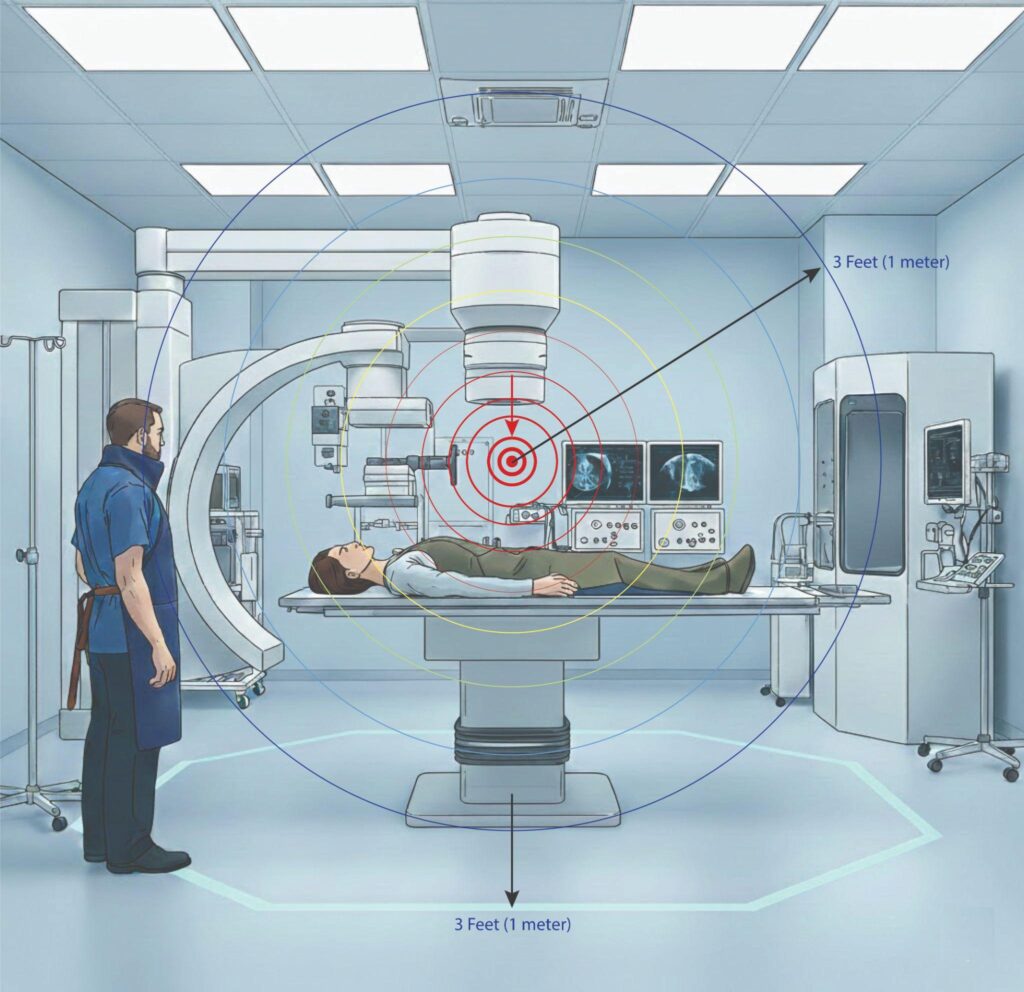
Choosing a core thickness less than 0.5 mm (such as 0.3 mm or 0.25 mm) is strictly predicated on maintaining a 1-meter (3-foot) distance threshold.

The Distance Advantage: A staff member wearing a 0.25 mm 1-Meter Apron receives approximately half the radiation dose (7.5 uSv) of a proximity worker wearing a 0.5 mm apron within .5 meter (14.0 uSv).

Choosing a lighter core while respecting the 1-meter threshold provides superior protection with a 50% reduction in garment weight.

The Proximity Zone
(< 5 Meters)

Within this table-side range, staff are exposed to high-intensity scatter. A 0.5 mm Pb core is the necessary standard for this proximity.

The Safety Zone
(≥ 1 Meter)

At this distance, the inverse square law reduces incident radiation intensity by approximately 90%. Only at this threshold does a lighter core become a viable, legally compliant option.

Quantifying the Attenuation (75-100 kVp)

The following data directly compares the transmitted dose for a proximity worker (at 0.5 meters) versus a distanced worker (at 1 meter). It demonstrates that distance trumps core thickness for overall dose reduction.

Core Thickness
Distance
Classification
Attenuation %
5-min Dose per Procedure
0.50 mm Pb
0.5 Meters
Proximity Apron
96.5% (.4 Primary)
14.0 uSv
0.30 mm Pb
1.0 Meter
1-Meter Apron
94.2% (.1 Primary)
5.8 uSv
0.25 mm Pb
1.0 Meter
1-Meter Apron
92.5% (.1 Primary)
7.5 uSv

CT Gantry Shadow Consideration

In CT environments, the gantry acts as a primary shield. For staff working within the Gantry Shadow at a 1-meter distance, 1-Meter Aprons (0.25 mm or 0.3 mm) are exceptionally effective as the shadow further reduces the energy and volume of scatter photons.

Legal Compliance and Safety Margin

The primary goal is remaining within the legal limit of 4166 uSv per month (0.416 rem).

High-Volume Scenario (24 Procedures per Day): Based on 480 procedures or 40 hours of beam time per month:

30 mm Core (at 1m)

Cumulative dose is 2800 uSv (0.28 rem), or 67% of the legal limit.

25 mm Core (at 1m)

Cumulative dose is 3600 uSv (0.36 rem), or 86% of the legal limit.

Even in high-volume environments, the 0.25 mm core keeps staff safely within legal exposure thresholds, provided the 1-meter distance is maintained.

Conclusion for the Buyer

If your clinical role allows you to maintain a 1-meter distance, a 0.25 mm or 0.3 mm core provides a safe, legally compliant experience that outperforms a standard 0.5 mm apron used at proximity. This “1-Meter Apron” classification enables an informed decision that balances maximum radiation protection with long-term orthopedic health.

If you still aren’t sure which lead aprons are right for you, it’s a good idea to give us a call at 1-866-575-1307 or talk to us through our chat or e-mail us at service@phillips-safety.com

Our experts will be able to tell you what you need for your application.

SHOP LEAD APRONS

Become a Distributor

Volume Discount